Winds Howling

Fetching latest activity...

"From Russia With Love" vs. "Doctor No"

#Books #Bond

I’m trying to finish all 14 of the original James Bond books in the span of a year. I’m three months in and just finished the sixth, “Doctor No.” I was planning on writing just one blog post reviewing them all at the end, but I liked the fifth book, “From Russia With Love,” so much — and its follow-up, “Dr. No,” so much less — that I wanted to write about those two now.
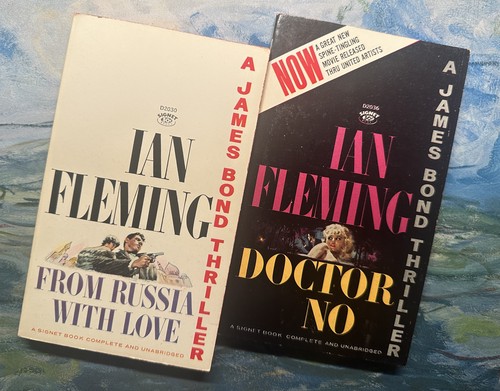
‘From Russia With Love’ and ‘Doctor No’

“From Russia With Love” felt like a real step up in ambition compared with the previous four books. Bond never even appeared until almost exactly 3 hours into the audiobook, but I wasn’t missing him. Instead, for several chapters, Fleming takes us to the Soviet Union and introduces us to one link after another in the chain of its spy bureaucracy as it hatches a plot against the West — against British intelligence — against James Bond.

Probably Fleming’s greatest achievement in the series so far is the steadily mounting sense of dread that pervades the first half of this book. A chess master is called away in the last moments of a tournament match to lend his genius to the planning. An assassin who goes murder-crazy on the full moon is interrupted in his poolside massage. Officials gather in a smoke-filled room to hash out the nefarious details of their attack. I have to admit all this luxurious set-up was better than the payoff, but it at least made up a hefty percentage of the book.

The series has already showcased some of the kookiness James Bond is known for, but “From Russia With Love” never goes there. I’m not saying “kooky = bad, grounded = good” — I guess it’s probably the kooky factor that really makes Bond Bond — but this book had a refreshingly mature tone. It’s almost plausible as a Cold War thriller. It’s the first one in the series that’s actually felt like a spy story. Even “Casino Royale,” while a simple and believable story, was really just a card game, a car chase and a torture scene — none of that says “spy.”

Even though these books are short, most of them have felt long to me so far. Not this one. The evil plot is planned, the evil plot is executed, and Bond responds. I can think of one definite filler scene, but it was one of the more memorable scenes in the book and definitely worth including.

Which brings me to “Doctor No.” “Doctor No” turned away from all of this in a way that almost rubs in your face: Bond is sent to Jamaica on what everyone acknowledges to be a lame assignment tantamount to a vacation. Echoing the worst of the previous books, there’s a specific racial fixation, this time “Chigroes,” or “Chinese negroes” (or even, as Fleming writes at one point, “Chinese Negroid”). The obligatory love interest ends up being a young islander who is functionally the equivalent of a child that Bond constantly has to patronize and gently pat on the head… but maybe also eventually have sex with? The villain, Doctor No, is essentially a comic book character. He lives inside a mountain, served by a private army of Chigroes, and has “jet-black” eyes that he at one point taps with his steel claw hands for dramatic effect.

It makes me wonder why Fleming even chose to write it. Bond’s apparent death at the end of “From Russia With Love” stemmed from Fleming getting bored with his hit character, toying with the idea of killing him off. Around the time he wrote “From Russia With Love,” Fleming apparently wrote in a letter:

I am getting fed up with Bond and it has been very difficult to make him go through his tawdry tricks.

So how did the idea of “Doctor No,” a book composed entirely of tawdry tricks, convince him to lift the death sentence?

I found the answer in “Goldeneye: Where Bond Was Born: Ian Fleming’s Jamaica” by Matthew Parker. The summer Fleming was “fed up,” he got involved with a Jamaican TV project whose story was “Doctor No” in outline. Even though it came to nothing, the project got Fleming moving again, Parker writes:

The combination of the freedom from Bond, and the Jamaica setting – a ‘home fixture’ – reinvigorated Fleming. … Fleming found that he suddenly had a fresh and inventive new Bond story ready to go. … Responding to later criticism, Fleming would declare: ‘Dr No was very cardboardy and need not have been … The trouble is that it is much more fun to think up fantastical situations and mix Bond up in them.’

I know I’m being no-fun to complain about this stuff — Doctor No’s mountain complex with the undersea viewing room was awesome, and I did actually love when he tapped his eyeball with his steel claw. For what it’s worth, Parker writes that this is “one of Fleming’s finest novels … one of the most fantastical, gothic and melodramatic; and at times frankly, even knowingly, over the top.” There’s certainly something to be said for all of that. It was just a smack in the face after “From Russia With Love.”

Leave a comment →
Haydn's Symphony No. 11

#Haydn #Music

I listened to this one on Sunday, in between a session of Warhammer 40,000: Space Marine 2 and loading the dishwasher.

Haydn

Right off the bat, I liked the mood of the opening movement (‘Adagio cantabile’) — stately and serene, but somehow slightly off. The melody it keeps returning to has some off-color notes that give it an interesting hue. Time seems to compress and expand slightly as long notes give way to smooth runs of shorter ones, giving it a feeling of gently rocking back and forth. A noticeable element of this movement is the occasional tolling of low bell-like notes, backed up by the horns (0:42, 2:30, etc.). Camilla said this made her imagine a city waking up in the morning. The more I listen to this movement the more I like it.

The second movement (‘Allegro’) was mostly noticeable for its high, rapidly scraping strings. It gets dramatic in a fun way, with a crescendo bursting into a satisfying chord progression, but these moments have a tendency to suddenly go quiet and lose momentum. For good, loud, classical drama, though, this does the job well.

The third movement (‘Menuetto con trio’) seemed to match the courtly vibe of the first movement, but was a bit meandering and never quite caught my ear.

Then, as has become a pattern here, we come to the ‘Presto’ finale. The opening seconds hooked me in — quiet, fast and tense before fully opening up. From there, the frequent twirling of the strings tended to dominate my attention. Another particularly good finale.

That was a pretty decent one overall — two good fast movements, an interesting, likeable slow movement, and a redundant, slightly boring slower movement for good measure. I wanted to give this one 4 stars out of 5, but it didn’t feel like it could really earn a 4 while having an entire movement I frowned upon. So I’m giving it 3.5 stars.

Version listened to: Hogwood
Length: 21:56
Next up: Symphony No. 18

Leave a comment →

A walk to Lakeside Island Park

#Michigan #Metro-Detroit #Lakeside #Walking

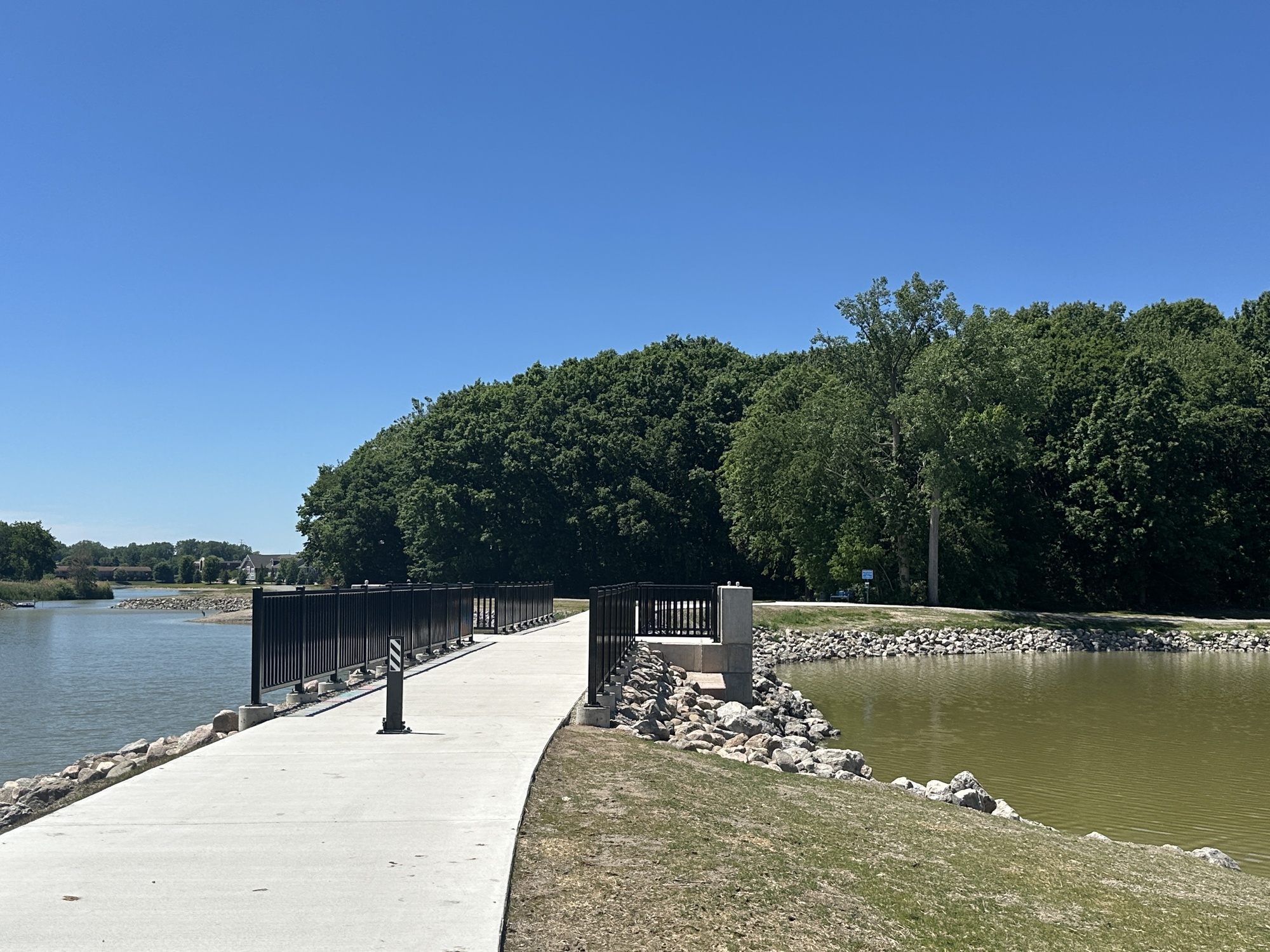
Here are some pictures from my walk today at Lakeside Island Park, an interesting patch of nature near me — one of the few patches reachable by foot. It’s a small island in a man-made lake outside a dead mall, the appropriately named Lakeside Mall. “Lakeside” is less appropriate for the island, since the island is in the lake, not beside it, but I only just realized that while writing this. “Lakeside” is a strong brand name here; the mall was super popular, and half the stuff in a square-mile radius is called “Lakeside” something or other. The word has even survived the mall itself: it is closed and pending redevelopment into a downtown-ish nucleus called Lakeside City Center.

That being so, this little park is probably headed for a new chapter. Access is currently limited to one bridge from a quiet residential area, but plans for a new bridge associated with Lakeside City Center were mentioned at a recent Sterling Heights City Council meeting. I’ll write about this island again soon to describe its current state in fuller detail.

Bridge to island

Sterling Heights has recently been at work improving the island, presumably spurred by the broader Lakeside project. It was closed for most of last year while they replaced the bridge, making it smoother and wider. The previous one had uneven, buckling concrete and, if I remember correctly, a series of metal bollards down the middle. The new bridge has a single bollard at the front — I assume they’re able to remove this quickly if they need to.

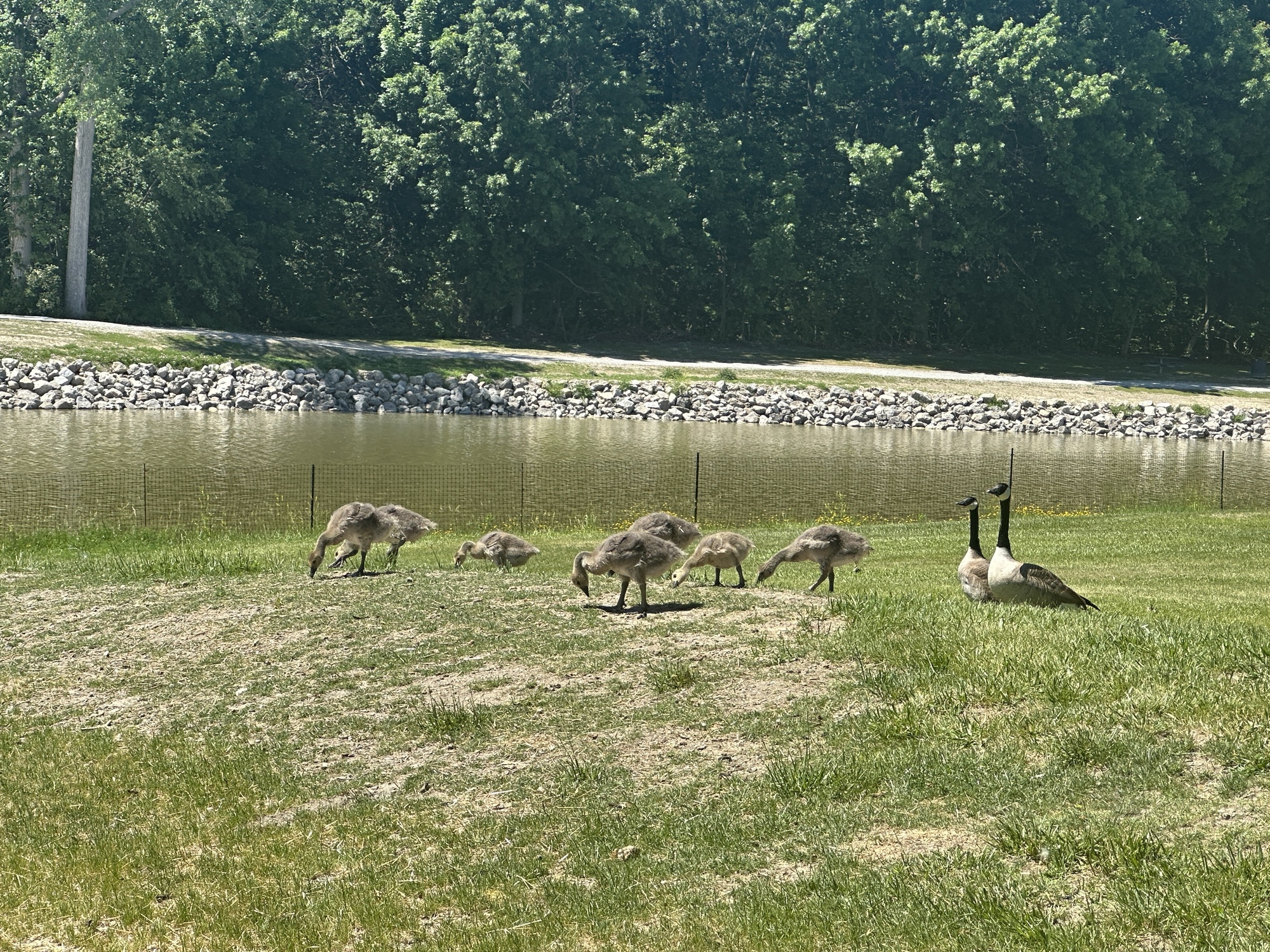
Geese family
A family of Canada geese hanging out by the bridge. Today I learned they’re technically called Canada geese and not Canadian geese.
Read more →

The new ITC Trail in Sterling Heights

#Michigan #Walking

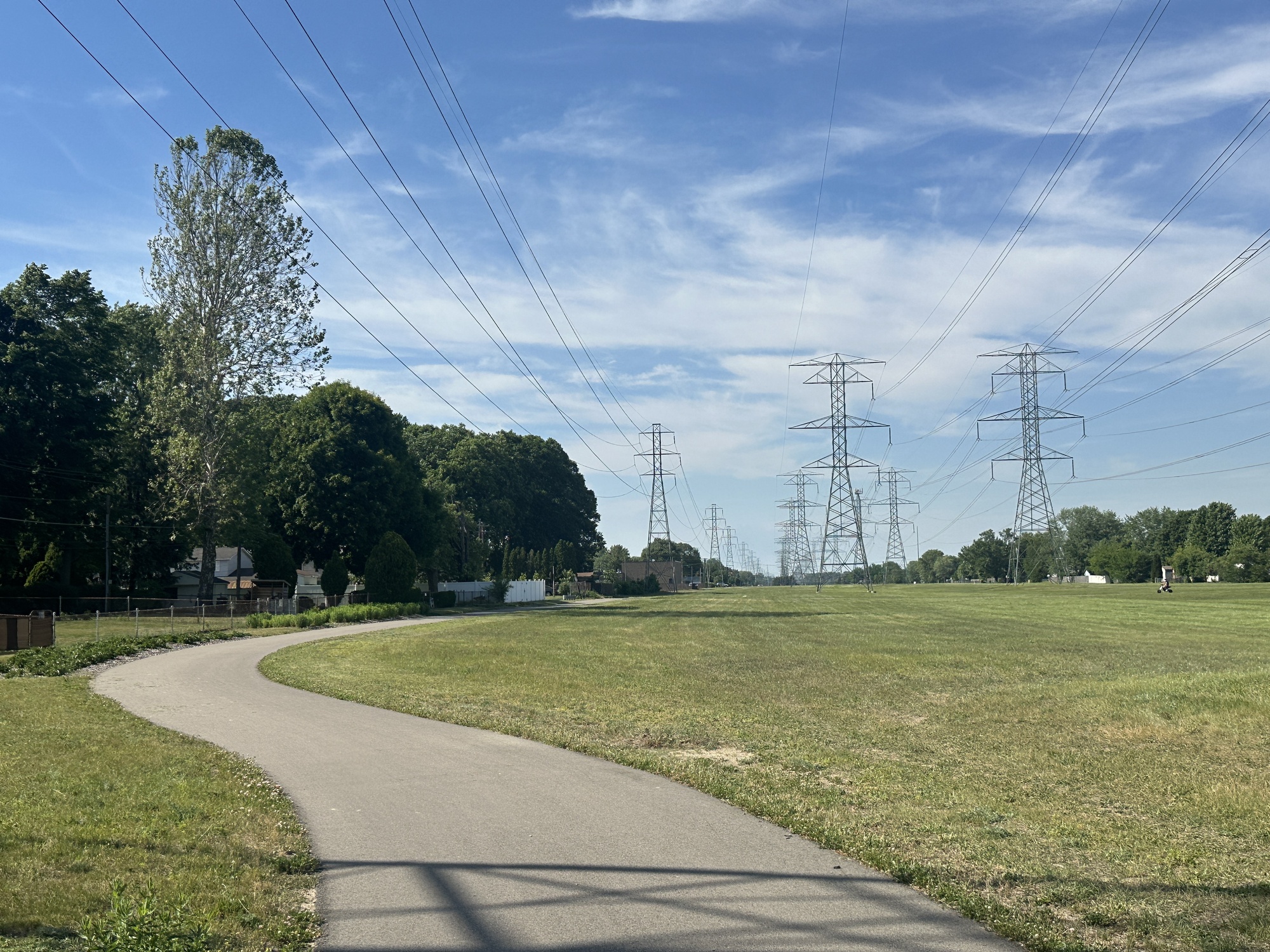
Two days ago, I checked out the ITC Trail in Sterling Heights for the first time. It’s a new trail that opened last year, a roughly 3-mile paved pathway through what was formerly only a power line corridor with neighborhoods on either side. The acronym in the trail’s wonky name stands for International Transmission Company, which operates the power lines. Most importantly, the trail is just a couple of miles away from me, something not to be taken for granted in the car-dominant sprawl.

ITC Trail

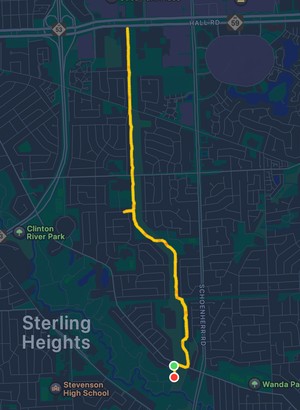
From one end of the trail to the other and back again, I walked 6.19 miles, spent 2 hours and 12 minutes, saw 22 other people using the trail and got barked at by three backyard dogs. The temperature was at its daily high of 87F for most of the walk. The fact of being beneath power lines meant there were no trees for shade, but a slight breeze made it tolerable.

Walk map

Even a trail as simple as this is a huge boon to the experience of being on foot in this particular area, and there is talk of additional trails that could hook up to this one. They cut the ribbon on it last May after a couple of years of work and around $3.2 million from the American Rescue Plan Act. That money also went toward improvements at the obscure cul-de-sac that serves as the parking area. All in all it sounds like a pretty good and easy story for a new pedestrian path in metro Detroit; resident complaints must be buried in Facebook comments or City Council minutes, because news coverage of them is slim.

Keep reading for a timestamped log of everything I saw and thought along the trail.

Read more →

Haydn's Symphony No. 10

#Haydn #Music

This is the first delayed Haydn symphony post. I listened to Symphony No. 10 yesterday while resting my feet after a 6-mile walk down a new trail, which I’ll be writing about soon. But since I’d already published another post about our recent Cleveland trip, I decided to sleep on this one and save it for today. I’m still following the order laid out in the notes for the Christopher Hogwood recordings, so I skipped from No. 5 to No. 10. I listened to the Hogwood version.

Haydn

The first movement (‘Allegro’) was a good fast opening, with more palpable emotion than has been in previous intros, plus punchy horns taking everything up a notch. It struck me as one of the better intros of this series so far, if not the best — the other one I remember liking a lot was from Symphony No. 1. The ending was awkward and sudden, though. Things slowed down for the second movement (‘Andante’), which was slightly interesting but mostly a bit boring. I’ve listened to it a few times now, and each time I end up thinking, “wait, this is still going?” It’s mostly a lot of high violin stuff; the melodies were momentarily interesting but forgettable, and the whole thing was a minute or two too long. A couple of cool repeated passages revolved around long held notes on the violin. The finale (‘Presto’) was peppy and chirpy, interlaced with some darker, quieter passages where the strings seem to all slide around together in a roiling mass, then go silent before the pep bursts forth again. The melodies weren’t as striking as the first movement, but this was still pretty good.

I rate this symphony 4 stars out of 5. The next is Symphony No. 11.

Leave a comment →

Two days in Cleveland

#Travel

We recently got to spend a couple of nights in Cleveland. We spent most of our time walking all over downtown, visiting six breweries and finally checking a pair of lighthouses off our list.

We’ve passed through Cleveland a couple of times before, thought it seemed like a really cool city and always wanted to spend more time there. On the way down to see the eclipse in 2024, we went to their art museum, the Rock and Roll Hall of Fame and a nearby submarine tour. We also hiked some Cleveland Metroparks last year, and we tried to stop downtown and see the lighthouses, but there was crazy traffic and we aborted the mission. This was the first time we really got to see all the Cleveland we wanted to see.

It didn’t disappoint. Coming from Detroit, it’s similar in a lot of ways, but nicer, cooler, bigger and cleaner. It feels like it’s been better taken care of. It seems like a more people-friendly place to live. Buses and trains were on the move. There were seemingly no homeless people, and only once did we have to navigate past a group of off-putting individuals on the sidewalk.

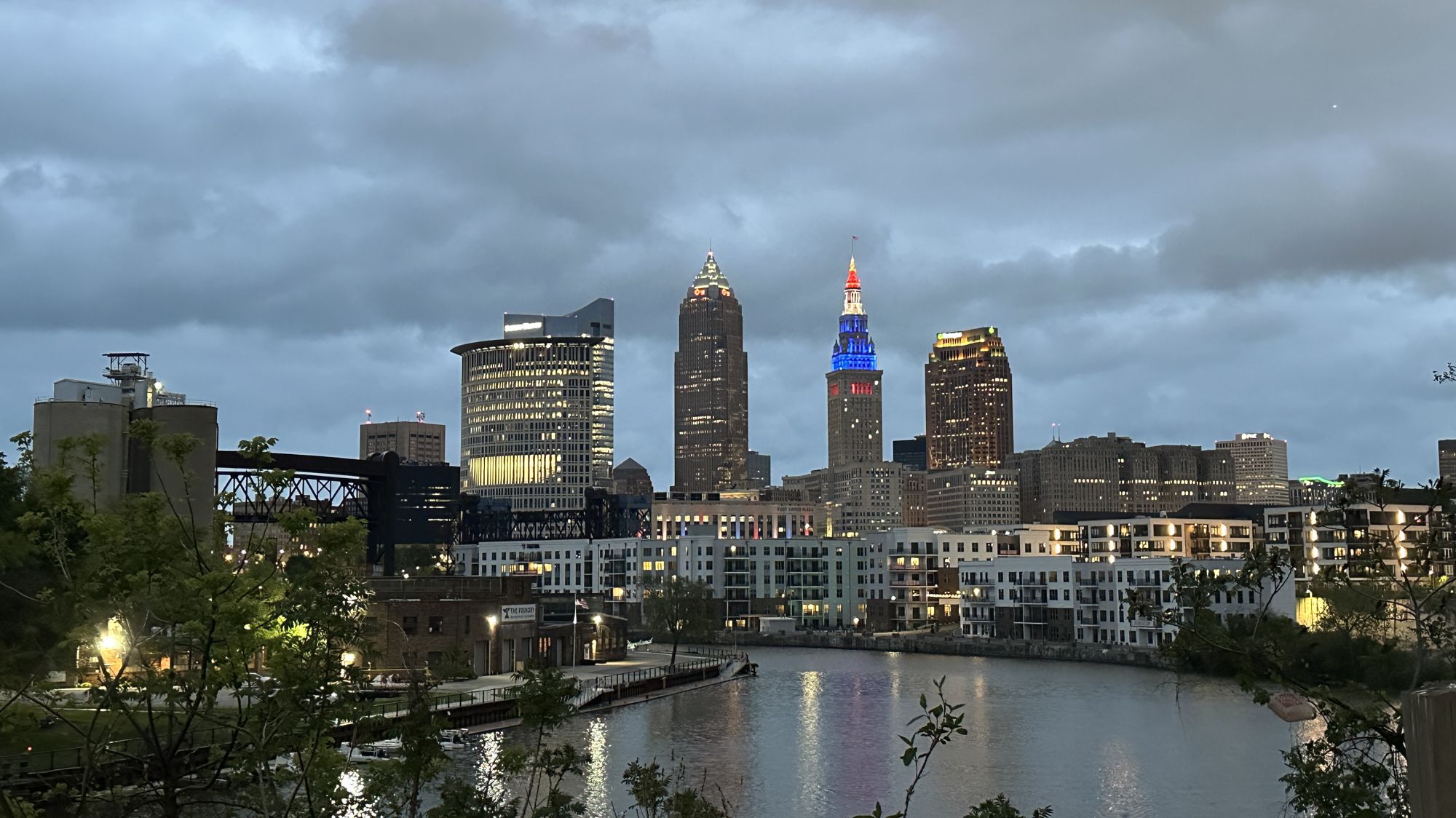
Cleveland skyline

Read more →

Haydn's Symphony No. 5

#Haydn #Music

Cam and I listened to Haydn’s next symphony on my lunch break. She’s been following along with the daily listening so far. Today was Symphony No. 5, for which we used the version by the Austro-Hungarian Haydn Orchestra & Ádám Fischer on Apple Music. No harpsichord in this one either.

Haydn

The first movement (‘Adagio ma non troppo’) was mainly notable for the big, soft sound of horns. It was nice background music but didn’t do anything particularly striking or memorable. The second (‘Allegro’) was a step up, with some playful upturned notes, a cycle of enjoyable melodies that repeats a couple of times, and some palpable dramatic moments. This was a pretty strong movement.

This was the first symphony of the series to have the structure that later became traditional: four movements, the third of which is a minuet or some kind of dance. I think Haydn’s supposed to have been one of the key guys who made that popular. But in this instance there were no real sparks for the third movement (‘Minuet and trio’). On to the fourth movement (‘Presto’) — the only thing that really caught my ear was the rapidity of notes at certain moments. Otherwise it was another fine two-minute outburst to close out the symphony.

I rate this symphony 4 stars out of 5.

On a side note, I listened back to the second movement of yesterday’s Symphony No. 4 last night. It is a pretty interesting and entrancing bit, aside from the ‘haunted house’ metaphor I mainly focused on yesterday.

Leave a comment →

Haydn's Symphony No. 4

#Haydn #Music

I’m still following James Webster’s chronology from the Hogwood recording notes, so it’s Symphony No. 4 next, not Symphony No. 3. They put No. 3 in another volume of symphonies with less certain dating. I listened to this one while warming up and eating a slice of leftover frozen pizza. I went with the harpsichordless Hogwood recording again.

Haydn

Symphony No. 4 was a slight bit more interesting than No. 2, but still not quite as good as No. 1. The opening movement (‘Presto’) is again a fun, propulsive few minutes, occasionally buckling into a quirky moment and shifting into a mysterious moment. The second movement (‘Andante’) immediately sounded like haunted house music — or as Webster put it:

It welds three separate rhythms – freely developing melody, beginning messa di voce; sinuously syncopated, melodically active inner part; “walking” bass – into a mood that is not easily described, but once heard is not easily forgotten.

It was a tad bit interesting, had some pleasant moments and was definitely different to what I’ve heard so far, but it never really emerged from sounding like background music to a Luigi’s Mansion level.

The third movement (‘Tempo di menuetto’) was something new. The other two symphonies each ended with a big exciting Presto, but this was a slightly boring dance that didn’t feel like it had a good sense of flow or much going on.

I rate this symphony 3.5 out of 5.

Leave a comment →

Haydn's Symphony No. 2

#Haydn #Music

Back with Haydn’s Symphony No. 2, clocking in at a crisp 8-and-a-half minutes.

Haydn

The opening movement (‘Allegro’) had me tapping my foot. The foot-tapping was so strong that I kept tapping even through the lighter, softer moments where it briefly switched to more mysterious chords. The next movement (‘Andante’) really did nothing for me — just a wandering, uninteresting, and constantly trilling melody. Occasionally it generated a moment of interest by shifting to a darker key. The third movement (‘Presto’) had a decent energy level but never really caught my interest, though it did briefly suggest to my mind the image of a galloping horse.

For the listening order, I’m currently following a revisionist chronology laid out by the musicologist James Webster in the notes for a series of Haydn recordings released in the ’90s. Reading those notes yesterday, I was surprised when Webster said “Haydn almost certainly used no keyboard instrument in his symphonies, except in London.” I’d just got done listening to Symphony No. 1, which had a harpsichord through the whole thing! Somehow along the way it became traditional to play Haydn with a harpsichord. The recordings Webster was writing for, conducted by Christopher Hogwood, ditched it and are therefore “the first on original instruments to realise Haydn’s sonic intentions in this essential respect.”

So for Symphony No. 2, I switched to Hogwood. It’s definitely more peaceful without the harpsichord. As soon as I found out it wasn’t technically supposed to be there, the incessant harpsichord in Symphony No. 1 became the equivalent of a ringing cellphone in a movie theater. It’s just a redundant chime, never really doing anything interesting or adding anything other instruments aren’t already doing. So I think I’ll mostly be looking for non-harpsichord recordings.

I rate this symphony 3 stars out of 5.

Leave a comment →

Haydn's Symphony No. 1

#Haydn #Music

Am I actually going to listen to all 106 symphonies by Joseph Haydn? I’m not sure, but I started with Symphony No. 1 today.

Haydn

From what I’ve gathered, this was written around 1757 when he was about 25 years old, serving as the personal musicmaker of a Bohemian aristocrat. I listened to the Philharmonia Hungarica version from the Complete Symphonies album on Apple Music. The whole thing was a little under 15 minutes. My cat sat on my lap about halfway through.

The opening movement (‘Presto’) had a few really strong moments of rising notes and the feeling of building toward an explosion — I think in the business they call it a “crescendo”? The second movement (‘Andante’) was like a brisk dance that periodically shifted to a minor key and did some big low notes; it had potential, but by minute 4 my mind was wandering. The third movement (‘Presto’ again) perked back up and finished strongly; it’s short and wild and had my favorite bit of the whole symphony, a cartoonish melody that it kept returning to, with notes that quickly scooted upward in pitch.

Out of 5 stars, I rate it 4.

Leave a comment →