I’m trying to finish all 14 of the original James Bond books in the span of a year. I’m three months in and just finished the sixth, “Doctor No.” I was planning on writing just one blog post reviewing them all at the end, but I liked the fifth book, “From Russia With Love,” so much — and its follow-up, “Dr. No,” so much less — that I wanted to write about those two now.
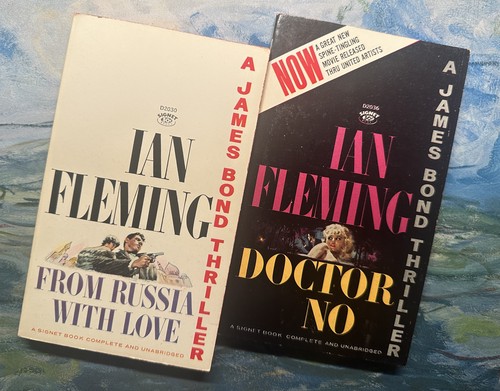
“From Russia With Love” felt like a real step up in ambition compared with the previous four books. Bond never even appeared until almost exactly 3 hours into the audiobook, but I wasn’t missing him. Instead, for several chapters, Fleming takes us to the Soviet Union and introduces us to one link after another in the chain of its spy bureaucracy as it hatches a plot against the West — against British intelligence — against James Bond.
Probably Fleming’s greatest achievement in the series so far is the steadily mounting sense of dread that pervades the first half of this book. A chess master is called away in the last moments of a tournament match to lend his genius to the planning. An assassin who goes murder-crazy on the full moon is interrupted in his poolside massage. Officials gather in a smoke-filled room to hash out the nefarious details of their attack. I have to admit all this luxurious set-up was better than the payoff, but it at least made up a hefty percentage of the book.
The series has already showcased some of the kookiness James Bond is known for, but “From Russia With Love” never goes there. I’m not saying “kooky = bad, grounded = good” — I guess it’s probably the kooky factor that really makes Bond Bond — but this book had a refreshingly mature tone. It’s almost plausible as a Cold War thriller. It’s the first one in the series that’s actually felt like a spy story. Even “Casino Royale,” while a simple and believable story, was really just a card game, a car chase and a torture scene — none of that says “spy.”
Even though these books are short, most of them have felt long to me so far. Not this one. The evil plot is planned, the evil plot is executed, and Bond responds. I can think of one definite filler scene, but it was one of the more memorable scenes in the book and definitely worth including.
Which brings me to “Doctor No.” “Doctor No” turned away from all of this in a way that almost rubs in your face: Bond is sent to Jamaica on what everyone acknowledges to be a lame assignment tantamount to a vacation. Echoing the worst of the previous books, there’s a specific racial fixation, this time “Chigroes,” or “Chinese negroes” (or even, as Fleming writes at one point, “Chinese Negroid”). The obligatory love interest ends up being a young islander who is functionally the equivalent of a child that Bond constantly has to patronize and gently pat on the head… but maybe also eventually have sex with? The villain, Doctor No, is essentially a comic book character. He lives inside a mountain, served by a private army of Chigroes, and has “jet-black” eyes that he at one point taps with his steel claw hands for dramatic effect.
It makes me wonder why Fleming even chose to write it. Bond’s apparent death at the end of “From Russia With Love” stemmed from Fleming getting bored with his hit character, toying with the idea of killing him off. Around the time he wrote “From Russia With Love,” Fleming apparently wrote in a letter:
I am getting fed up with Bond and it has been very difficult to make him go through his tawdry tricks.
So how did the idea of “Doctor No,” a book composed entirely of tawdry tricks, convince him to lift the death sentence?
I found the answer in “Goldeneye: Where Bond Was Born: Ian Fleming’s Jamaica” by Matthew Parker. The summer Fleming was “fed up,” he got involved with a Jamaican TV project whose story was “Doctor No” in outline. Even though it came to nothing, the project got Fleming moving again, Parker writes:
The combination of the freedom from Bond, and the Jamaica setting – a ‘home fixture’ – reinvigorated Fleming. … Fleming found that he suddenly had a fresh and inventive new Bond story ready to go. … Responding to later criticism, Fleming would declare: ‘Dr No was very cardboardy and need not have been … The trouble is that it is much more fun to think up fantastical situations and mix Bond up in them.’
I know I’m being no-fun to complain about this stuff — Doctor No’s mountain complex with the undersea viewing room was awesome, and I did actually love when he tapped his eyeball with his steel claw. For what it’s worth, Parker writes that this is “one of Fleming’s finest novels … one of the most fantastical, gothic and melodramatic; and at times frankly, even knowingly, over the top.” There’s certainly something to be said for all of that. It was just a smack in the face after “From Russia With Love.”
Comments
Leave a comment