Winds Howling

Fetching latest activity...

Announcing the Now page

#Site-News

I’d like to announce a feature that’s been quietly operating on this site for a couple of weeks now: the Now page. It’ll tell you what books I’m reading and what books and movies I’ve recently finished, pulling data from my Goodreads and Letterboxd profiles. If I end up thinking of more information I can feed it, I’ll put that there, too.

You can access it by clicking the text under the site’s header, which is set to display whatever the Now page’s latest update is. Currently it reads: “Started reading “William the Conqueror” by David Bates yesterday.” It’ll probably say something else by the time you read this.

I like the concept of Now pages, which are meant to show what you’re actually doing and working on, but they tend to get out of date, and stay out of date for a long time, once their makers get tired of maintaining them and just go back to living their lives. That’s the fate that befell the Quest Log soon after I launched it earlier this year — it was just another log among many logs I keep on my life, and it turned out to be one too many. I like that my Now page keeps itself updated. Brought to you by Claude Opus.

Leave a comment →

Haydn's Symphony No. 107

#Haydn #Music

With this symphony I’ve reached the end of the first grouping of Haydn’s earliest symphonies, as laid out by Academy of Ancient Music in the notes to their complete recordings. Haydn composed these symphonies around 1757 to 1760 while he was the court composer for a Bohemian aristocrat named Count Morzin.

Symphony No. 107 has a much higher number than the others up to this point (which have ranged from 1 to 37) — this is because it was originally classified as a string quartet and not renumbered as a symphony until after the other numbers had already been solidified.

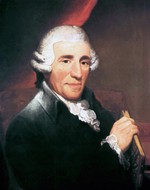
Haydn

The first movement (‘Allegro’) is strong on horns and dramatic chord progressions, and there’s a striking, almost film-soundtrack-like climax that arrives at 2:15 and 3:50. This all kept me interested for the duration of the movement, but it wasn’t particularly charming or interesting.

“Dull, classical elevator music” is all I have to say about the second movement (‘Andante’ but mislabeled as ‘Allegro’ on Apple Music and YouTube).

This symphony wakes back up for the third movement (‘Allegro molto’ but mislabeled as ‘Andante’ on Apple Music and YouTube). Strings are constantly swirling with energy, horns are chiming in, everything’s generally firing on all cylinders. But it wasn’t very strong on melody and didn’t leave me with much to remember when it was over, aside from its sheer energy.

I rate this symphony 2.5 stars out of 5. It kept me actively listening for most of its duration, but it didn’t truly capture my interest. A couple lines from these symphonies have actually gotten stuck in my head along the way, but I don’t think anything here will be doing that.

Version listened to: Academy of Ancient Music/Christopher Hogwood
Length: 14:22
Next up: Symphony No. 3. It’s the first in the next batch of symphonies set forth by Academy of Ancient Music. These next ones are of uncertain origin, being made either for Count Morzin or the Hungarian nobles that Haydn composed for next.

Leave a comment →

The Russians dug the deepest hole on Earth

#History

A recent xkcd comic about the deepest manmade holes in the world had me flying to Wikipedia to learn more about these holes.

I was delighted to learn that the deepest of them all, the Kola Superdeep Borehole SG-3, was a Soviet Union project specifically aimed at digging the deepest hole they physically could. After 19 years of digging, their third attempted hole reached a depth of 7.6 miles in 1989. Around this time, an urban legend emerged that Russian scientists somewhere out in Siberia had dug too deeply and broken through to Hell.

After briefly surviving the fall of the Soviet Union, the project ran out of funds and shut down in 1995. A documentary claiming to contain “almost the only known real footage of work going on” at the hole is available on YouTube from a fellow named David Smythe, who conducted research there shortly before its closure. He wrote about that research here, along with this summary of what scientists learned from the hole:

The hole yielded several new scientific results, not least that the Soviet picture of the crust, where granitic rocks give way to basaltic rocks at about 7 km, was proved to be wrong. The granitic rocks continue much deeper, as western scientists believed. There was also water in the crust, an unexpected discovery, and traces of former life in the form of microfossils at 6 km depth.

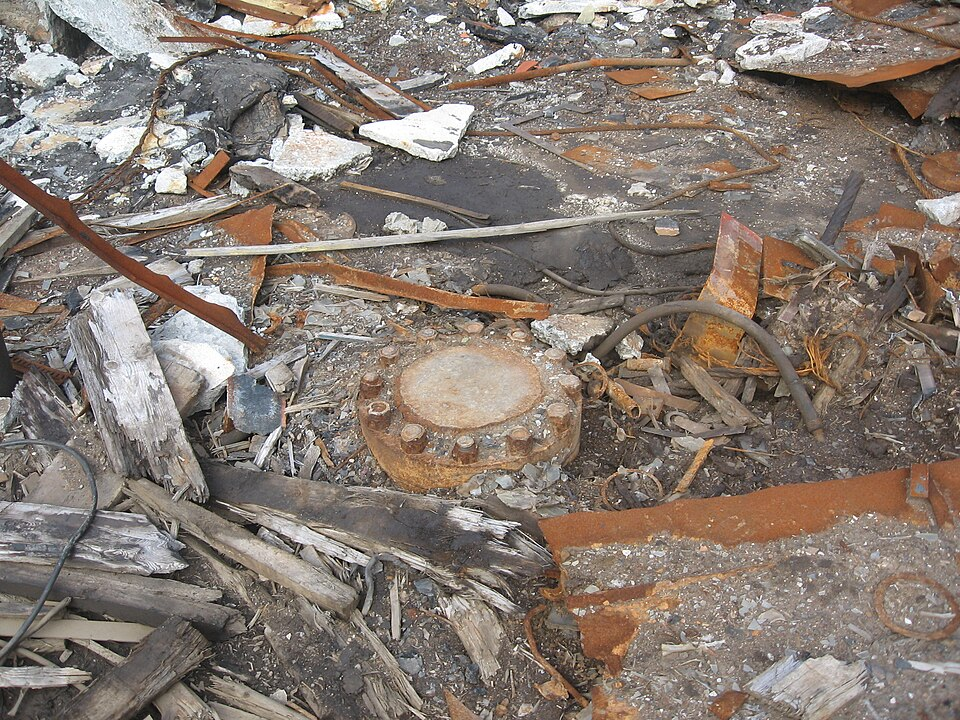
Today the structures around the hole seem to have been basically destroyed. The deepest manmade hole in the world, about 9 inches in diameter, is now covered by a rusty metal cap surrounded by similar-looking debris.

Cap
Photo: Rakot13
Leave a comment →

America 250

#America-250

Today is the 250th birthday of America, that is, the semiquincentennial date of the adoption of the Declaration of Independence. I’m celebrating by seeing the Detroit Symphony Orchestra do the 1812 Overture with “cannon fire and a brilliant fireworks finale” this evening at Greenfield Village.

This is the only big anniversary of my home country that I can count on seeing in my lifetime. I’m not sure 275 is a number we’ll be as excited about, and I’ll be 78 when the 300th anniversary comes around, so that one’s a coin flip. My younger sister’s lifespan is more definitely within reach of the tricentennial year of 2076, and for that I am somewhat jealous, because it’s a much cooler anniversary when it actually ends in “76.”

I think it’s a bit of a shame that the anniversary is wrapped up in so many bad vibes, presided over without much flair by an administration devoid of taste, but there’s probably never really a good time for it. The 1976 bicentennial seems to be fondly looked back on today, even though it came in its own post-Vietnam era of stagflation and “malaise.”

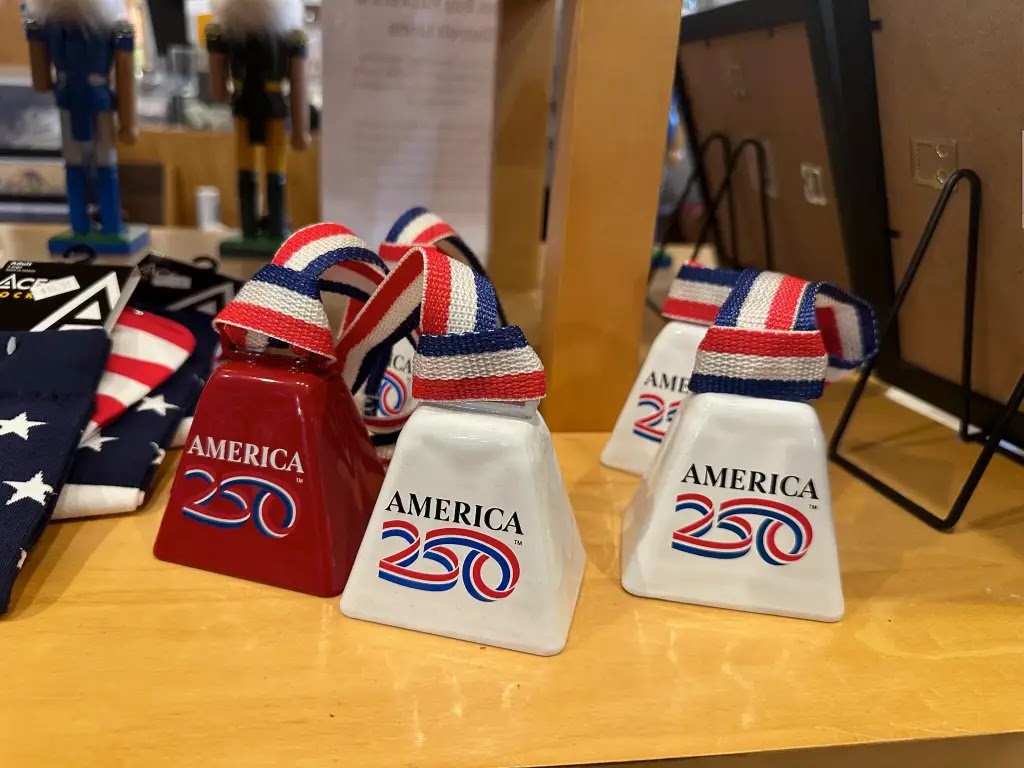
I don’t really know how it overcame those headwinds, but even today there is a chipper and charming patriotism about 1976 memorabilia that tends to bring a smile to my face when I come across it at an antique store or garage sale. I’m curious to see whether “America 250” ephemera achieve the same effect. The merch I’ve seen on the shelves so far this year hasn’t been very impressive — lots of generic trinkets and bits of apparel with a mention of the anniversary stamped on. A perfect example is the very first item I noticed, back in November (which I wrote about in my first post on this blog): souvenir bells in the gift shop at Grand Traverse Lighthouse.

Bells

The one great artifact of this year, for Michiganders at least, is the commemorative license plate, which is a reissue of the one Michigan made for the 1976 bicentennial, just with a “26” in the corner instead of “76.”

License plate

The 1976 plate is one of my favorite license plate designs. I see it every once in a while, because people like to put it on random old vehicles, and I’ve always wished I could have it. This reissue is only available for purchase in 2026, so I had no real choice but to buy it now.

Leave a comment →

Haydn's Symphony No. 37

#Haydn #Music

I first listened to this on June 14, the same day I first listened to Symphony No. 32, but never wrote it up until now. I listened to it again today.

Haydn

The first movement (‘Presto’) was jaunty and fun, but none of the melodies jumped out or got stuck in my head. The second movement was a pretty average ‘Menuet and trio’ — you can picture a line of people in wigs and dresses blandly dancing across a shiny floor. I liked the extended dramatic passages through the middle section, starting around 1:30 here.

Things got good with the third movement (‘Andante’). It caught my attention right off the bat with a moaning, declining melody that repeats and repeats. This was one of the more striking motifs of all these symphonies so far. About 30 seconds in, this declining melody starts to repeatedly rise in pitch, creating an interesting paradoxical effect and leaving me in suspense wondering how high it would go. By minute 3, it’s gone through a few evolutions and several overlapping instruments are playing it off each other in a satisfying culmination. One of the better movements so far, if slightly too long.

The fourth movement is a ‘Presto’ finale that has a few good bits and doesn’t overstay its welcome. The main cool thing is that it likes to have the brass come in with a big, low note, followed by a screeching response from the strings.

Those last two movements were both above average, but the first two were average or below. That seems to add up to 2.5 stars out of 5, but I’m going to swing it up to a 3.

Versions listened to: Austro-Hungarian Haydn Orchestra & Adam Fischer; Academy of Ancient Music/Christopher Hogwood
Length: 16:50
Next up: Symphony No. 107, due to quirks of Haydn scholarship outlined by musicologist James Webster in this guide I’m following. Apparently it was “long thought to be an early string quartet” until scholars reclassified it as one of Haydn’s earliest symphonies in the 1950s.

Leave a comment →

Announcing the comment section

#Site-News

As of today, each post on this blog has a section at the bottom where you can leave a comment, anonymously if you wish.

I’ve been looking at comment sections of other blogs recently and getting a bit jealous. My Hugo set-up didn’t come with any way to do it — Hugo is a “static site generator,” after all. So I prompted this into existence using Claude Opus. My friend Kareem left the first-ever comment on my article yesterday about Unity Park, confirming that it works, or at least seems to work.

If a post has comments, a speech bubble and the number of comments will appear next to the date and tags. Currently I need to manually approve all comments, but I may end up changing that.

(Notes still don’t have comments, though, at least for now.)

Leave a comment →

Park honoring explorers, rooted in controversy, to be built in Clinton Township

#Metro-Detroit #Michigan

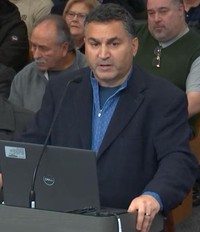
Clinton Township has officially greenlit a new park, called Unity Park, which has its origins in local controversy over Columbus Day and Indigenous Peoples Day. The Board of Trustees unanimously approved the plans at their meeting on Monday.

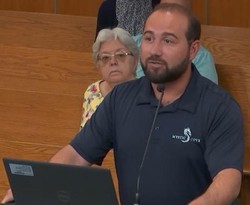
“The point of this park was to say, enough of the divisiveness. We’re all immigrants. We’re all Americans,” said the developer behind it, Dominic F. Moceri. “We need to unite and be one, and this park is really here to celebrate that.”

Dominic F. Moceri
Dominic F. Moceri

The idea for the park goes back to 2022, when the township replaced Columbus Day with Indigenous Peoples Day on its own calendar. Its board meetings were relatively rowdy for a couple weeks, with lots of public comment from self-declared Italian Americans, until eventually they restored Columbus Day and moved Indigenous Peoples Day up a couple of months. Shortly before that vote, a big local developer, Dominic J. Moceri, uncle of the one mentioned above, announced this park for the first time. For more about all the drama, read my previous post.

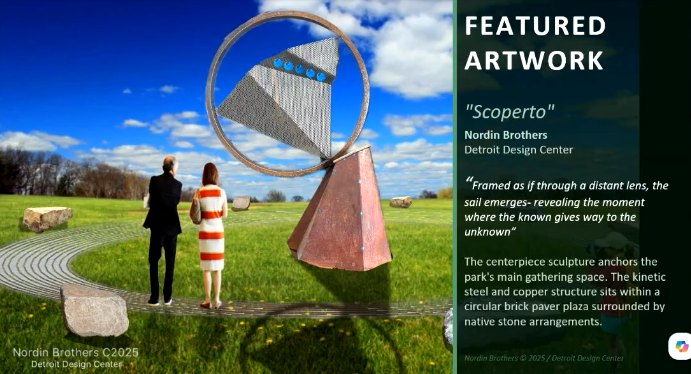
On one level, it’s hard to argue with the plan, which consists of some brick pathways and a sculpture. (The base has seven sides, representing the seven continents; the protruding circle is sort of a telescope through which you’re seeing a sail; the five blue orbs are the five oceans). The site is currently a grass field that was otherwise approved to hold townhomes. A park is a park.

Park and sculpture mock-up

But if you honestly wanted to bridge the two sides of this particular “division,” as the developers have repeatedly said, I’m skeptical that a park that’s really only about “exploration” and “discovery” is a thoughtful way of doing so.

We’ve been told the park will offer historical information about explorers, but hardly anything has been said about how it will present what is presumably the “other side” of the culture war implied by the name “Unity Park.” What about Native Americans? Back in 2022 the elder Moceri mentioned Native American iconography being part of the park’s logo, at least, but that logo hasn’t been shown at any meeting this year, and in the first place its design was, hilariously, one of Columbus’ ships, the Santa Maria, at sea. When a board member asked him if the park would mention anything about slavery, he ambiguously responded, “If they’re Americans, they’ll be included. If they’re guests, they’ll be included,” and then launched into a history lesson about how Africans did slavery, too. The park is practically in the front yard of the Italian American Cultural Society, and it was originally presented with the alternate name of “Parco Unita.” So I remain unconvinced that it’s much more than a venting of grievances dressed up as a grand community gesture, for which the Moceris have already received multiple rounds of obsequious public gratitude from township officials.

Dominic J. Moceri
Dominic J. Moceri

There’s something defensive and insecure to me about this park, as it’s been proposed. What “division” actually exists here? Why does this short-lived, slightly myopic controversy need to be implicitly dredged up with a name like “Unity Park” in the first place? It’s already four years old and getting older all the time. Even Township Supervisor Paul Gieleghem seemed to want to move on: “We don’t need to revisit that,” he said as the younger Moceri started to dive into the backstory before the vote on Monday.

Leave a comment →

What I got wrong about the new mural in Sterling Heights

#Metro-Detroit #Michigan

Since writing about the “Greetings from Sterling Heights” mural the city is putting on the side of its new pickleball building, I’ve been in touch with the artist painting it, Wendy Popko, and she pointed out a few things I got wrong in my analysis of the design. Here are some corrections and nuances.

The mural has big block letters spelling “Sterling Heights” filled with images of local landmarks and traditions. Here’s the design Popko submitted to the city:

Proposed mural design

In my original post, I went letter by letter, writing what I saw in each one. Some of them went over my head. I also overlooked two landmarks elsewhere in the design and wrongly stated that one of them was not there at all.

S: Not a dog, as I wrote, but the “Two Bears” sculpture outside the Sterling Heights Public Library. Here’s a photo from when it was installed in October 1981.

S

TE: Not simply a person playing guitar and hands making hearts and peace signs, as I wrote, but a representation of free concerts held at Sterlingfest and weekly during the summer at Dodge Park.
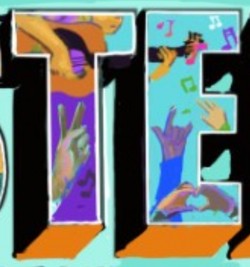
TE

HT: I mostly got this right, that this was a representation of the city’s ethnic diversity, but Popko added that it also stems from the Cultural Exchange event the city holds every year in March.

HT

S: This skateboarder isn’t just any skateboarder — he’s a stand-in for the skate park by the library. The bicyclist represents the city’s biking trails in general, Popko said.

S

I also wrote that the large circular sculpture with which Sterling Heights kicked off its identity-building phase, known locally as The Golden Butthole, was nowhere depicted on this celebration of local landmarks. I was, however, wrong. It’s in the bottom left corner, rising like the sun from behind a depiction of Upton House, another thing I missed. Upton House is the oldest house in the city, dating to 1866, and is now a museum situated just outside Dodge Park. In my original post, I smugly observed that all the landmarks I could identify were less than 10 years old, mostly artifacts of the mid-2010s redevelopment of Dodge Park. Now I concede I overlooked one that predates the formation of the city by 102 years.
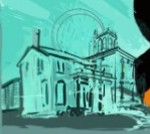
Upton House and Halo sculpture

I also made much of there being a certain hollowness in this attempt at self-mythology by Sterling Heights. The city specifically commissioned this “postcard-style mural” to commemorate itself on the north wall of a pickleball complex that it spent nearly $10 million on, using funds from a big city improvement millage it successfully campaigned for in 2024. As I’ve written, the city is also planning to demolish the mall that was once its signature institution and redevelop the site into a walkable, mixed-use area, of which there are precious few for miles around. I’d argue that in this mural you can feel the city playing catch-up with itself, trying to emerge from its bland suburban anonymity and invent an identity where none had previously existed.

In fairness, Popko told me she had no trouble mining Sterling Heights for material.

“To be honest, I feel like I ran out of letters,” she said.

Leave a comment →
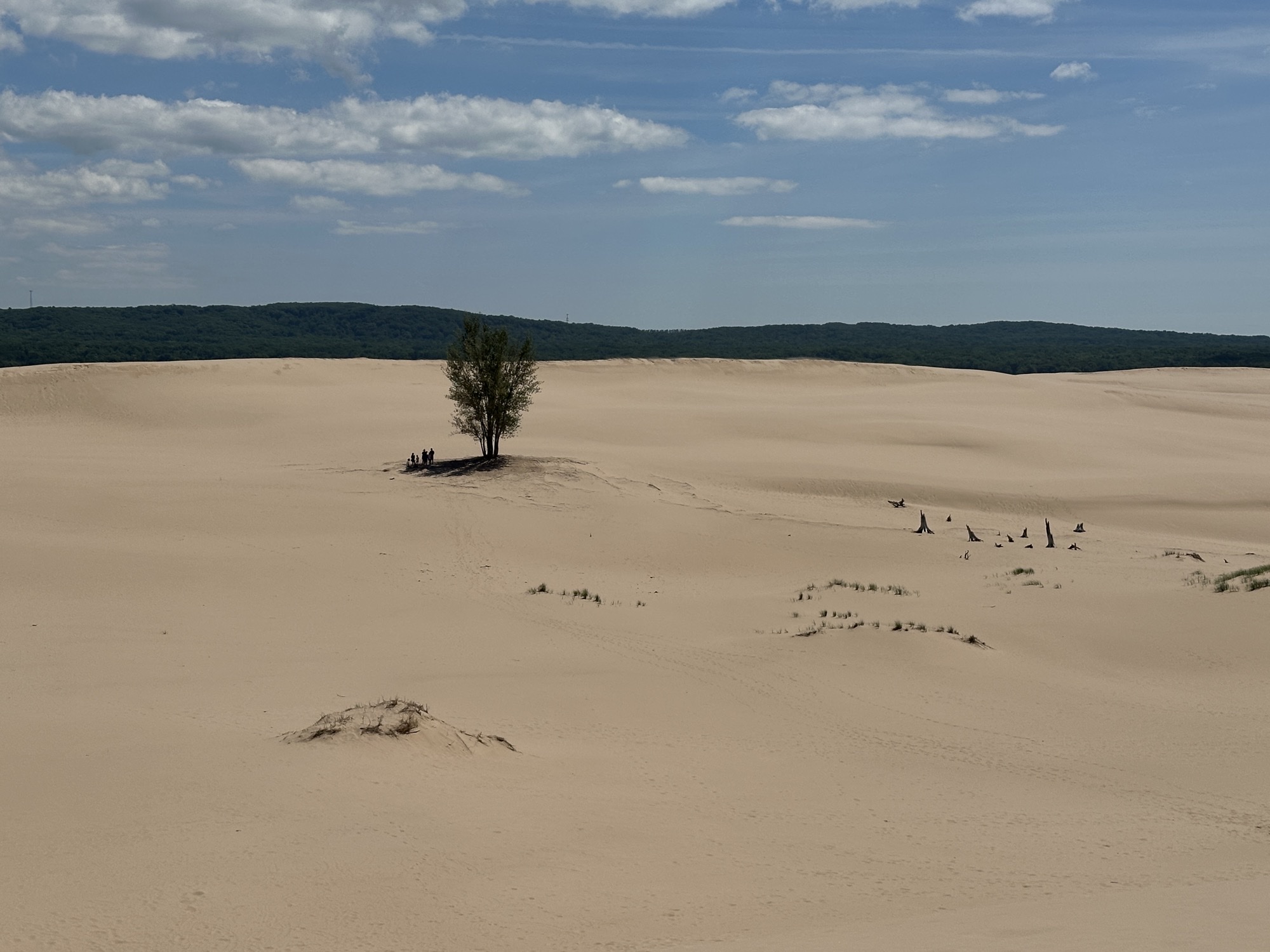
Morning at Silver Lake State Park Campground

Pleased to be among the dunes