Winds Howling

Fetching latest activity...

"An Account of the Discovery of the Body of King John" by Valentine Green

#English-Monarchs #History

King John of England was buried in Worcester Cathedral in 1216. On this day 229 years ago — July 17, 1797 — people opened his coffin and took a look at him for the final time that we know of. It was shut again the following day.
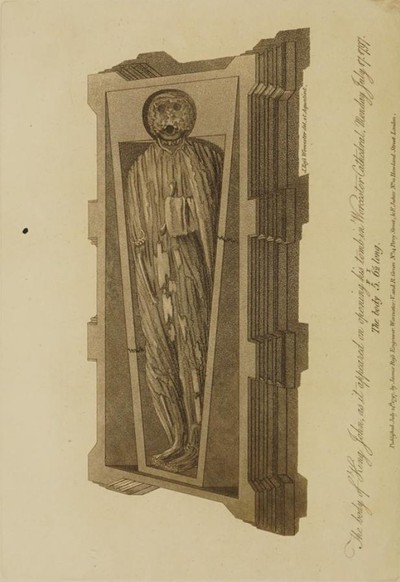
Engraving
‘The body of King John as it appeared on opening his tomb in Worcester Cathedral, Monday July 17, 1797.’

Shortly thereafter, the engraver and antiquarian Valentine Green published a short description, based on the testimony of several people who’d been there, of the king’s status at the end of the eighteenth century — the “displacing of the jaws, the loss of the bones of the hands,” the “vast quantity of the dry skins of maggots,” et cetera. Since I couldn’t find the full thing in raw text, I transcribed it below, along with the footnotes, based on a PDF from the website of the Wellcome Collection.


Among the various circumstances which eventually produced the discovery of the body of King John to have been deposited in the tomb in the choir of the cathedral church of Worcester, the following, as the most prominent, are conceived necessary to be stated.

In the course of my researches into the History of that Cathedral, and a minute examination of its fabric and monumental remains, for the purpose of forming a part of my new edition of “the History and Antiquities of the City and Suburbs of Worcester” published in two volumes, quarto, 1796, I was led to adopt the opinions of the most eminent and learned of our antiquaries who appeared to have joined in a conclusion, that although the original interment of King John had taken place in the Lady’s chapel of that cathedral between the sepulchres of the Saints Oswald and Wulstan, before the altar of the blessed Virgin, yet that the effigy of the king, at the time of the reformation was removed from his grave, and laid upon the tomb which had been newly erected in the choir to receive it, and that this was done without removing the body, which was conjectured to have been left in its original state of sepulture in the Lady’s chapel.

These conclusions deduced from the accounts and authorities of Leland, Abingdon, Dr. Stukely, Brown Willis, Mr. Garbet, Mr. Gough, Dr. Nash, and others, had been opposed by Dr. Thomas, and Mr. Dougharty;1 the first affirming the interment of King John to have been in the choir, in the place on which the tomb now stands; and the last that the royal body remained within the tomb. After weighing those opposite opinions with the most scrupulous attention, and proving by actual measurement the assertion of Dr. Thomas “that graves could be made there” to be erroneous;2 and that Mr. Dougharty had asserted that which it would seem he had not actually examined; and also that what he advanced was invalidated by another respectable authority, which states from what must have been imagined the result of careful inspection, “that no bones were found in the sepulchre.”

Thus warranted by ancient and modern testimony, and strongly fortified by personal investigation; together with a modern altar tomb before me of the precise form and stile of embellishment of that of Prince Arthur in the adjacent chapel, and probably the work of the same artists, it was felt that without better proof to the contrary, it would have been a presumption savouring too much of pertinacity, to have asserted that the remains of King John were first deposited there, or that any other sign of him was to be expected out of his grave in the Virgin’s chapel, than the effigy of his person cumbent on the cenotaph in the choir.

The principle of those opinions had been adopted by me so early as 1764, and then made public in the first edition of the Survey of Worcester (see p. 40) and in 1788 personally discussed with the Honourable and Reverend Dr. St. Andrew St. John, late Dean of Worcester, who was induced from what then passed on the subject, to adopt the resolution of opening the tomb to ascertain the fact; but his death which happened previous to the publication of the second edition of the History of Worcester, preventing the intended search, those conjectures, with much auxiliary and concurrent support, were again avowed, and have again been published.

In the present revised and enlarged form those conjectures are now presented, they have fallen under the notice of the Reverend Dr. Arthur Onslow, the present worthy Dean of Worcester, to whom, in a conversation on the general repair of the interior of the cathedral, which his judicious taste had already planned for the improvement and beautifying of it, I again ventured to suggest the opening of the royal tomb; and if, upon examination, no vestige of the sepulture should appear, its removal from thence to the Lady’s chapel, and there erecting it over the ancient grave in which King John’s remains were supposed to lie, would be a measure fully sanctioned by propriety in respect of its appropriate designation, and in which portion of the cathedral it would also prove a befitting and dignifying object. As a measure of expediency, its removal had long been the wish of many, thereby to restore the orderly conduct of the devotional services of the church, subjected to much annoyance by the present position of the tomb, especially in the approach to the altar.

The caprices of modern reformation having no share in the projected arrangement, much less the unnecessary and indecent disturbance of royal inhumation: useful accommodation and the attainment of decorous order suitable to the solemn purposes of the place being the ultimate objects in view, on Monday the 17th of July 1797, the taking down of the tomb of King John was proceeded upon in the following order.

On the removal of the royal effigy, and the stone slab on which it had been laid, and which had been broken in two in some former operation about the tomb, the objects first presented to view within it, were two partition walls of brick, raised to assist in the support of the superincumbent covering and figure of the king, and to take an equal bearing of their weight with the side and end pannels of the tomb. The spaces between those walls, and between them and the ends of the tomb were filled up with the rubbish of bricks and mortar. On taking down the pannel at the head, and one on each side, and clearing out the rubbish, two strong elm boards originally joined by a batten nailed at each end of them, but which had dropped off and left the boards loose, were next discovered, and upon their removal, the stone coffin, of which they had formed the covering, containing the entire remains of King John became visible!

Read more →
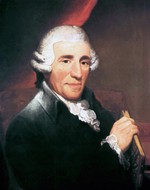
Haydn's Symphony No. 14

#Haydn #Music

I first listened to this symphony last week while waiting for a book club meeting to start (we read “No Country for Old Men”). I loaded the dishwasher, got a tea brewing, then sat down to eat a red popsicle. To refresh my memory, I listened to it again today while packing for a trip we’re about to take to Glacier National Park.

According to James Webster, Symphony No. 14 is the first of this series that seems to date to the period when Haydn was a court composer for the Hungarian Esterházy family. Up till now, they were most likely composed for Count Morzin in Bohemia.

Haydn

The first movement (‘Allegro molto’) had what I can only describe as a particularly “classical” feel. It almost feels like one of those classical pieces I’ve heard a million times before, but I’m sure it isn’t. The main refrain (this being the very first notes, repeated at 0:52, 3:13, etc) is stark and forceful and seems to stick confidently out in a way many of the recent symphonies haven’t.

The second movement (‘Andante’) was mainly characterized by little runs of notes up and down interspersed throughout the main string melodies. It’s pleasant and playful, but a bit stately and boring.

The third movement (‘Menuetto e trio - Allegretto’) caught my attention on the second listen with a minor-key oboe-led section around 1:16. But the more upbeat sections that bookend this part don’t do much for me.

The fourth movement (‘Allegro’) is a short energetic finale as has become custom. This was one among the better ones of those, if only because I especially liked the mood of the descending notes that occur at 0:51, 1:16 and elsewhere — it seems to somehow convey the sound of something ending, which is appropriate.

This was a little better than the average Haydn symphony so far, especially compared to the recent run, but it still didn’t strike me as particularly interesting.

Version listened to: Academy of Ancient Music/Christopher Hogwood, Philharmonia Hungarica & Antal Dorati
Length: 16:20
Next up: Symphony No. 15.

Leave a comment →

Announcing New Music

#Site-News #New-Music #Music

Over the past decade I’ve been coming slowly uncoupled from any awareness of recently released music. This would be an entirely normal statement if I were a little bit older, but I’m only 28. So I made a mid-year resolution to listen to more new music, and to that end, I recently started a review series on this blog, called “New Music,” where I will listen to recent albums and share my thoughts.

As a teenager I listened to a lot of dubstep, EDM and later the indie rock and neo-psychedelia of the 2010s. But toward the end of high school I got obsessed with Bob Dylan, and I spent the next three or four years listening almost exclusively to him. This was the closest I’ve come to being an insufferable superfan of anything. That Dylan listening laid the groundwork for a slow, then sudden, shift in focus to country music, which really hit during the Covid lockdown and kept me busy through the Biden administration. The first country music that I liked was the 1950s and ’60s honky-tonk style that plays on Willie’s Roadhouse on SiriusXM, which primed me for my recent phase: ’50s music (also powered by SiriusXM, this time ’50s Gold). More recently, I’ve been going even further back into classical music.

All of which has left me feeling increasingly alienated from the human race, like an 80-year-old man before my time. What is everyone listening to? Where is music going during the time I’m alive? I haven’t been keeping track. New Music is an attempt at reversing course.

My first entry includes five albums from the last two months. I think I’ll keep roughly that lookback window and try to do a couple of entries a month, at least. I’ve got another one almost lined up already.

Leave a comment →

Jurassic Park in Concert

#Music #Movies

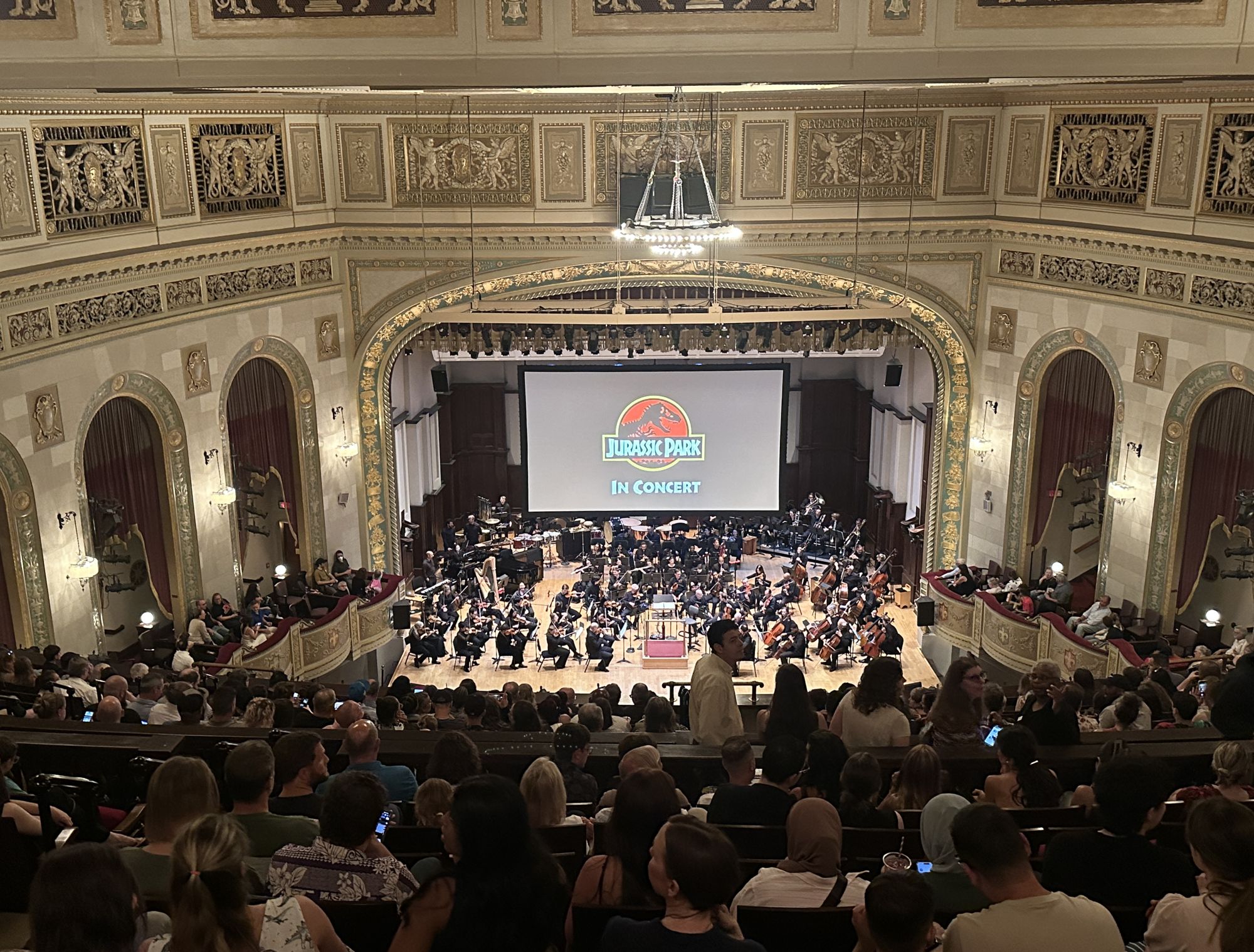
Three days ago, I watched my favorite movie, “Jurassic Park,” with live musical accompaniment from the Detroit Symphony Orchestra.

Orchestra

Yesterday, Sam Neill died. Rest in peace.

Sam Neill

It was my first time seeing something like this. It was pretty great to see a big orchestra perform the music along with the movie, but maybe not as great as I assumed it would be. It was difficult to appreciate both the movie and the music at the same time. Once the lights dimmed on the orchestra and the movie got going, I quickly forgot the score was actually being performed live. Even when I tried to examine the activity on stage, it was mostly too dark to see, and the screen blocked a lot of players in the back. Occasionally there’d be a music-less, dialogue-heavy part, and when I knew the music was about to kick back in, I’d watch as the musicians primed their instruments and the conductor raised his baton.

I was mostly locked in on the movie. The orchestra hall acoustics frequently drowned out the dialogue, but subtitles made that problem easy to ignore. The audience intermittently clapped for the orchestra, which helped to remind me it was there. There was also much hooting at the big shot of sweaty Jeff Goldblum reclining with his shirt unbuttoned. A ten-minute intermission came just before Dennis Nedry was killed by a dilophosaurus.

It was a fairly normal watching experience for the most part. There weren’t even any opening or closing speeches. Nobody other than characters in the movie said anything for the entire show. But it was still a much cooler than average viewing of “Jurassic Park.”

I’ve seen this movie many times but this time noticed two things I hadn’t before:

  • Between Dr. Grant and Dr. Sattler being invited to the island and them seeing a dinosaur for the first time, no one actually mentions the fact that the park involves dinosaurs. Hammond initially tells them that the park is “right up your alley,” and, if you listen closely, just before she sees the first brachiosaurus, Dr. Sattler mentions a leaf from a plant that’s “been extinct since the Cretaceous period,” but that’s it. The nature of the park is supposed to be a secret, sure, but nobody even seems to have any questions popping into their heads as they’re being loaded into “Jurassic Park”-branded Jeeps.
  • Dr. Grant loses his hat during the initial T-Rex attack. It’s blown off his head by breath from the rex’s nose and never recovered.
Leave a comment →

My least favorite parts of "No Country for Old Men"

#Books

Book cover

He leaned and spat. Damn, he said.

I believe that. And I’ve thought about that a lot.

I’ve thought about it a good deal.

Wendell leaned and spat.

I got out and kindly shook myself off and got back in and just set there. Just kindly collectin my thoughts.

Wendell turned and spat.

He stood there thinking about that.

He leaned and spat.

Well, he said. Some things dont change, I reckon.

What would that be? the old man said.

Hell, I dont know.

I dont either.

I stood out there a long time and I thought about things.

Bell was standing with his hands in his back pockets. He leaned and spat.

Bell looked at Torbert. Torbert leaned and spat.

He just set there and nodded. He was settin in a swing and he just rocked back and forth a little and held that glass of tea in his lap. I didnt know what else to say so I just shut up and we set there for quite some time.

The next day was goin to be my last day in the office and I had a good deal to think about.

He walked down the steps and out the back door and got in his truck and sat there. He couldnt name the feeling.

Leave a comment →

Grand opening of the Sterling Heights Athletic Hub

#Metro-Detroit #Michigan

A little after 10 a.m. on Saturday, Sterling Heights cut the ribbon on its latest project: the Sterling Heights Athletic Hub. I went to see it happen with a friend who lives nearby.

Ribbon cutting

The name “Athletic Hub” is sort of a euphemism obscuring the fact that it’s really just indoor pickleball courts with ping-pong tables on the side. The city built it inside the abandoned shell of a former drug store and later Spirit Halloween, using $10 million in taxes from a big millage it passed in 2024. It’s sandwiched between another large empty building, formerly Target, and a brand-new apartment complex that’s still wrapping up construction.

“This area of the city is getting revitalized one step at a time,” Parks and Rec Director Kyle Langlois said during his speech at the ribbon cutting. “It’s amazing to look out and see what has happened in this area from really just 10 months ago. Google Maps hasn’t even caught up to what’s happened in this area.”

Google Maps screenshot
Google Maps as of 7/12/26. The grassy area on the right is where the apartments now are.

There was a surprising little crowd gathered to see the Athletic Hub open its doors, a concentration of sweating humanity in one corner of a large, desolate parking lot.

Crowd outside

We got in line with about 65 other people, and more filled in behind us. The line dissolved as soon as the event actually started and they called the crowd to gather up close to hear the speeches. After about 11 minutes of that, they urged everyone to line up behind the ribbon for a big group photo, calling it “a very monumental moment for our community.”

Ribbon cutting close-up

Once that was over with, everybody turned around and mushed into each other in an effort to be first through the doors, until somebody got on the microphone and directed the formation of a line.

Read more →

New Music #1: Charley Crockett, Sienna Spiro, Madeon, Pond, Boards of Canada

#New-Music #Music

Charley Crockett — Clovis
Released July 3

Clovis

This was a not-bad serving of nostalgia-inflected country music that only occasionally sparkled, mostly skating by on good vibes alone. A few of the rockers rose to the occasion (‘The Hallelujah Trail,’ ‘Country Music,’ ‘Down By Law’), and a notable darker tone showed through on ‘Top Hand’ and a menacing, sort of Nick Cave-y cover of Johnny Cash’s ‘Don’t Take Your Guns To Town.’ ‘Image of a Woman’ employed many of the exact same sonic hooks as my favorite Crockett song, ‘Midnight Run,’ but was nowhere near as good. ‘Clovis’ was an interesting diversion, a western-soundtracky instrumental composed by Stephen Barber with a good, ominous jaw harp part. Songs occasionally overstayed their welcome, and the production sometimes got in the way (see ‘Eagle and the Crow’), but I was never particularly offended — mostly just disappointed the album wasn’t making more of an impression.

Sienna Spiro — Visitor
Released July 3

Visitor

This is a showcase for “indie girl voice,” that strange accent that stretches vowels into extra syllables, underpronounces everything else and exists nowhere on Earth, so where it comes from I don’t know.

The main distinctive feature of Spiro’s voice is that it’s always on the edge of cracking, which sounds deeply emotive in a five-second snippet but quickly gets old when it goes on for an entire song. It almost sounds like her microphone is cutting out when you’re only hearing half of every word. Here’s my transcription of the beginning of track 2, “We’re Not In Love”:

aybe its the owa

aybe its the ay you ooked at me

now i been devowrr

theres no way that i could ever lee

These songs are mostly odes to submissive man-needing, a “fallen trad wife” shtick familiar from Lana Del Rey, a yearning for a man tinged with a yearning for patriarchy. It’s all there on the album cover.

The second half of the album picks things up a bit as Spiro lifts her voice for a few impassioned ballads with straightforwardly good, non-cringe lyrics. The title track is one of these. A couple others grew on me on the second and third listen: ‘He’s Not My Baby, I’m His’ is groovy enough to raise it up a notch, creepy age-gap lyrics notwithstanding, and one song, ‘Time, You & Me,’ got stuck in my head for most of Friday. But this one wasn’t for me.

Madeon — Victory
Released June 26

Victory

This is a shift away from Madeon’s poppy and optimistic style of electronic music towards something louder and harder-driving. A few of the synth leads were satisfyingly rough and sawtoothed (‘Car Crash Baby,’ ‘Red Jacket’), and I caught feelings of ‘Invaders Must Die’-era The Prodigy at times, especially on the lead track ‘Hi!’ A few vocal parts had genuine promise (‘Dancing On Your Grave,’ ‘Chaos Magic’), but the strongest vocals are paradoxically the most shrouded in distortion and electronica, so that they sound like overdriven samples of songs by somebody else.

The Madeon magic has been steadily dribbling away since his 2015 full-length album debut. It isn’t entirely gone, but it’s nearing undetectable levels on this album.

Pond — Terrestrials
Released June 19

Terrestrials

Pond is channeling various strains of underground ‘80s music — to my untrained ear much of it is stuff like New Order, The Cure or Love and Rockets. The vocals are theatrical and gothy, the guitars are detuned, and the margins are sprinkled with synth stabs and cheesy sound effects. The album never slowed down for the first five tracks, launching from one banger to the next (‘Casuarina,’ ‘Through the Heather’) before hitting a snoozer (‘The Fatal Shore’). Then came four more tracks that were somewhat less cohesive than what came before but seemed more strongly rooted as pieces of songwriting, rather than pieces of studiocraft. I only took notice of any of the lyrics during the last two songs (‘Personal Hell,’ ‘Nashville (I’m Dying)’).

This album was a good listen, but pretty low on songs I foresee wanting to hear again. The one thing that really stuck with me, that I’ve gone back to listen to, was the chorus of ‘Through the Heather.’ It’s made up of two parts — a soft little synth line and a two-note vocal part alternating up and down — that sound so good together.

Boards of Canada — Inferno
Released May 29

Inferno

A fair serving of Boards of Canada. You might hope there’s more to say, given it’s only their second album in twenty years, but I don’t have much. It sounds a lot like the Boards of Canada music I spent a lot of time shuffling while playing games as a teenager. Tracks are either entirely synth-driven or led by vocal samples, mostly of normal human speech, lightly chopped to fit the rhythm. It’s hard to get much meaning out of these garbled, context-free vocal snippets, but many of them seem like the sort of religious ramblings you might hear if you accidentally switch to AM radio. They make for a weird sort of music, but the Boards are good at making it fairly groovy. The album took all the way until track 12 to hit me with something strikingly good: the sitar-like synth lead in “Blood in the Labyrinth,” which is by far the standout track.

Leave a comment →

Reading through the English monarchs: Year one

#English-Monarchs #Books #History

A year ago today, I unknowingly embarked on a mission to read a biography of every king and queen who ever ruled England, of which there are about forty, if you take the low number.

At the time, I only meant to join my friend Mike in reading a biography of Edward I, who was king from 1272 to 1307. But I liked that particular book so much that I started to wonder, what if I just kept going with Edward II, Edward III…? Conveniently enough, all of these were available as audiobooks from the library.

A year later, I’ve read nine books covering eight kings and started a tenth. Two kings have been deposed, two have gone on crusade, Wales has been conquered and re-conquered, the legend of King Arthur has gained popular traction, longbows and cannons have begun to make battlefields a lot more scary, the Black Death made everything even scarier, the Hundred Years War began and seeds were sown for the Wars of the Roses.

Reading about all these kings in a row has turned out to be a pretty interesting way to learn about history. Each book moves the story forward for however long fate allows. Because a king’s life usually overlaps with the old age of his predecessor and the childhood of his successor, you end up hearing a lot of stuff multiple times, first when one king is old and again when the next is young. I like this; not only does it refresh your memory, but it usually gives you a slightly different historical take, cementing the long and winding story in your head even as it introduces new wrinkles and layers.

Here’s a brief review of all the books I’ve read so far in this series, plus impressions of the one I’m reading now. Use the table of contents below to skip ahead if you wish.

  1. Edward I
  2. Edward II
  3. Edward III
  4. Richard II
  5. Henry IV
  6. Henry V (Allmand)
  7. Henry V (Mortimer)
  8. Edward the Confessor
  9. Harold II
  10. William I

“A Great and Terrible King: Edward I and the Forging of Britain” by Marc Morris

Read from 7/10/25 to 8/4/25 (3 weeks and 4 days)

Edward I book

It took me a little while to get into this one, but once I did, I got pretty obsessed. It’s dense in the beginning, during the dwindling years of Edward’s father, King Henry III, who had reigned a long time and had lots of complicated loose threads by the time this book begins. But it becomes clearer and more propulsive once Edward is king, with full freedom of action. The author Marc Morris also struck me as a particularly good, informative writer of history — I’m eager to read another book of his.

This was the story of an adventuresome, mobile king. He’s on his way back from a crusade when he finds out his father is dead and he’s become king, and he proceeds to spend a lot of time leading armies through Wales and Scotland, to the extent that in London a certain lawlessness takes hold in his absence and a wool merchant robs his personal treasure at Westminster Abbey.

By the time Edward died, the consequences of his unsustainable warring were already becoming apparent, and he left a big mess for his incompetent successor, for all of which he must be knocked down a peg.

“Edward II: The Unconventional King” by Kathryn Warner

Read from 8/4/25 to 8/17/25 (1 week and 6 days)

Edward II book

Edward II is a character that I’m glad to have been introduced to. He was born to be king but had zero aptitude for it and no apparent desire to have any. He “preferred hedging, ditching and digging to jousting and fighting,” Warner writes. In war, he was either being horribly defeated by the Scots or cracking down on rebellious nobles. His main interest in kingship was its ability to enrich, ennoble and empower his close companions, especially two “favorites” who may or may not have been his lovers. The first of these was executed by the other nobles, and the other has a civil war named after him. All this led Edward II to be the first English king to be overthrown, and by his wife.

He’s supposed to have somehow died in captivity shortly thereafter, but Warner closes the book with a very interesting chapter outlining clues that Edward secretly survived another 15 years or so in exile. Probably the thing that stuck with me most from this book was her image of Edward living out his days as an anonymous hermit somewhere in Italy, finally getting some peace. He would have been a great Joe Rogan guest.

Read more →

Haydn's Symphony No. 3

#Haydn #Music

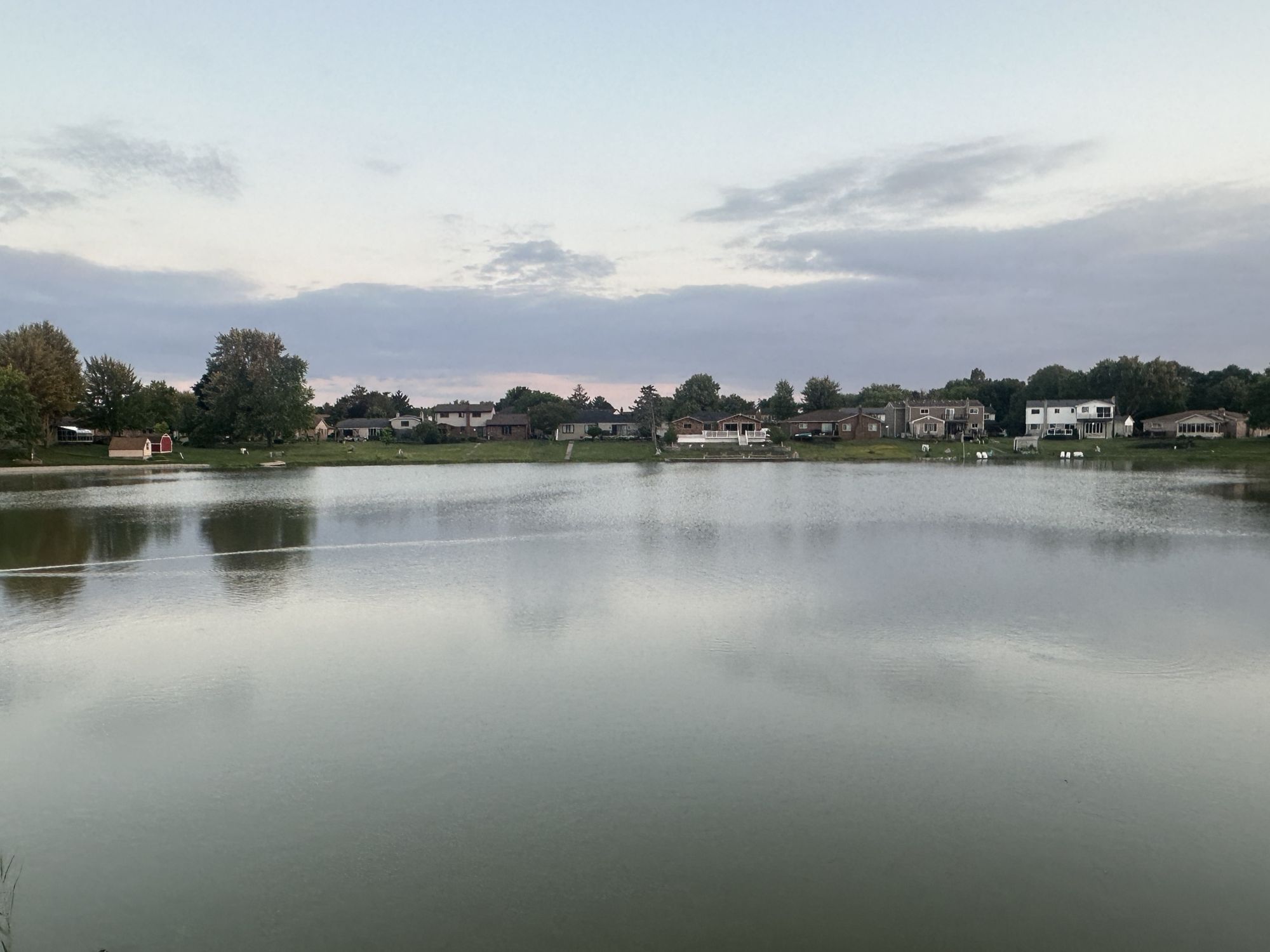
I first listened to Symphony No. 3 on Monday on a walk to the park, where I thought it would have its best chance to impress me. The peaceful sight of ducks swimming on the lake previously did favors for Symphony No. 32, after all. It was breezy and a little cloudy, but comfortable at 74 F.

Lake

According to James Webster, the music historian I’ve been citing for this series, this symphony probably dates to Haydn’s time as a court composer for Count Morzin, the same aristocrat the rest of these were written for so far.

Haydn

The first movement (‘Allegro’) is good from moment to moment, but overall felt like it was spasming around a lot without cohering into much. It’s at its best whenever the oboes appear — particularly the moody oboe-heavy section that begins around 2:20.

The second movement (‘Andante moderato’) has a two-note, upward-sweeping thing it likes to do, which occasionally layers across multiple instruments bouncing back and forth (0:40, 1:50, etc). This was pretty striking, but diluted by interludes that were less interesting.

The third movement is a ‘Menuet and trio.’ Past movements of this type have conjured an image of an old-time ballroom dance in my head; this one is a bit more lively and engaging and gives more of a royal parade type of feel. Oboes again were a strong point.

The fourth movement (‘Alla breve’) is dotted with exciting crescendos and buzzing with rapid strings. Even though it wasn’t a presto finale, its effect was similar to the prestos that have finished so many of the symphonies up to this point. According to Webster, this movement is “a masterpiece … a remarkable synthesis of fugue and sonata style … arguably Haydn’s first example of this important type of finale.” It sounds quite good to me, too.

I think I actually liked this symphony a bit less during my walk to the park than I did later at home, sitting in front of my computer, writing this. It’s average at worst; if it was ever boring, it wasn’t for long.

I rate this symphony 3.5 stars out of 5.

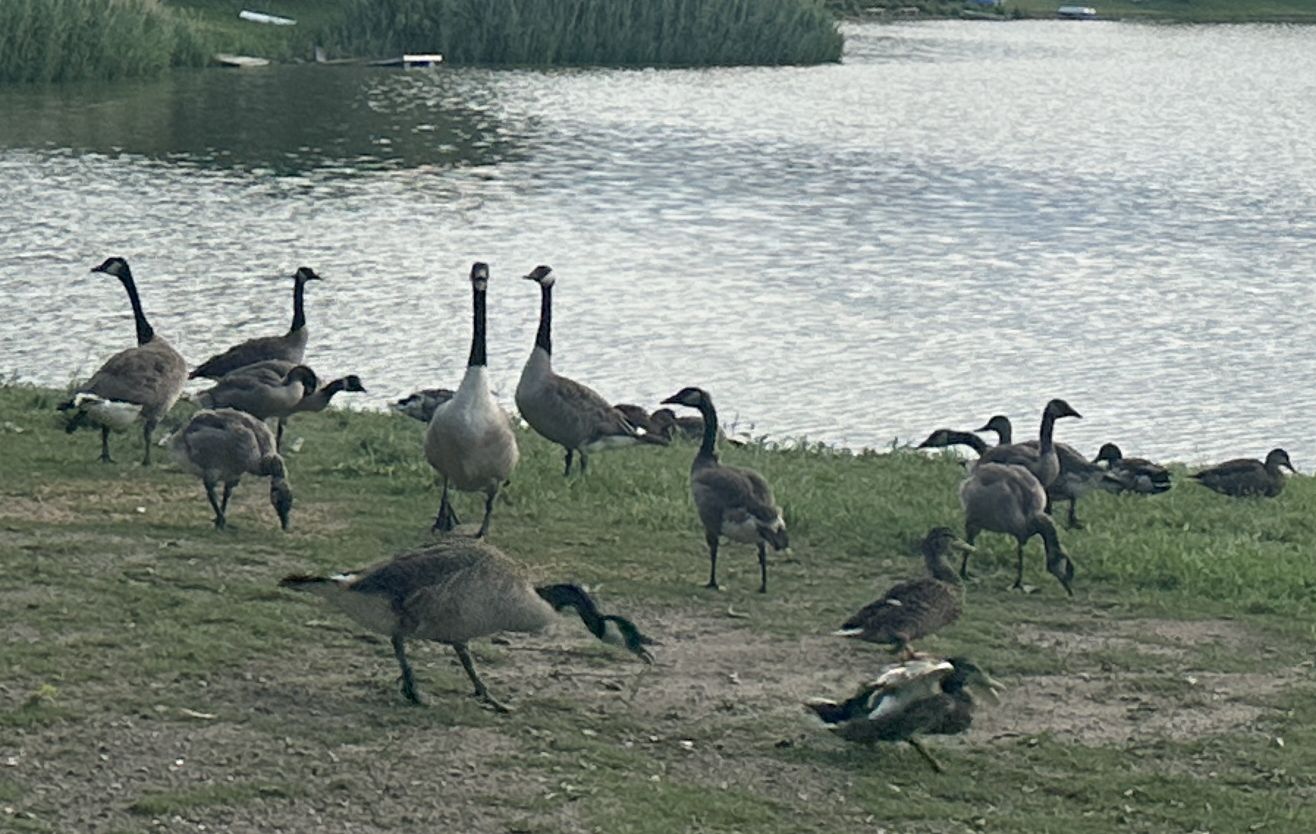
Goose and duck altercation
I caught this goose snapping at this duck around the third movement.

Version listened to: Academy of Ancient Music/Christopher Hogwood
Length: 17:39
Next up: Symphony No. 14.

Leave a comment →

Clinton Township reads the Declaration of Independence

#Metro-Detroit #Michigan #America-250

We’ve crossed into the rump end of America’s 250th year, but some towns are still getting their fireworks in, including my own, Clinton Township. They threw a big party outside the library ahead of a fireworks show after sunset. There were several bounce houses full of bouncing children and about a dozen food trucks slinging kettle corn, Korean corn dogs, fried chicken, pizza, ice cream and all the rest.

I didn’t go for the fireworks, though. I went for the event that kicked off the evening’s festivities: a 6 p.m. reading of the Declaration of Independence on the steps of the old town-hall-turned-historical-museum. I don’t think I’ve ever heard the whole Declaration read out loud before, and it had been about six months since I took any photos with my camera, so I went to have a look.

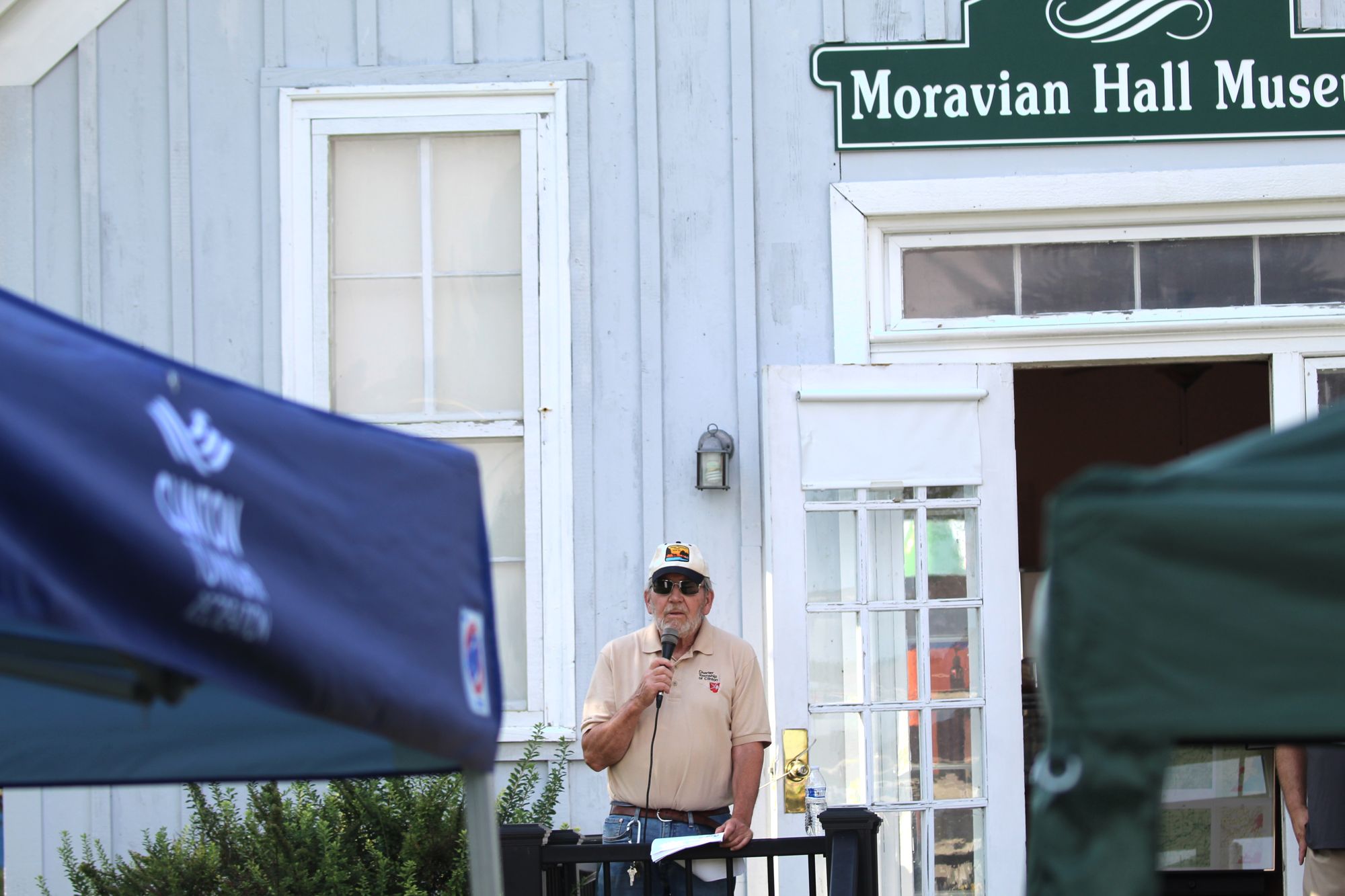
James Hungerford addressing crowd

The reader was James Hungerford, former teacher and chairman of the Clinton Township Historical Commission. I had hoped for the reader to be wearing some period garb, but Hungerford greeted us in plain clothes.

James Hungerford

I did, however, love his hat featuring the logo for the Clinton-Kalamazoo Canal, an unfinished canal that is one of the township’s main historical oddities.

Clinton-Kalamazoo Canal logo
This design is also on roadside signs marking the former path of the canal.

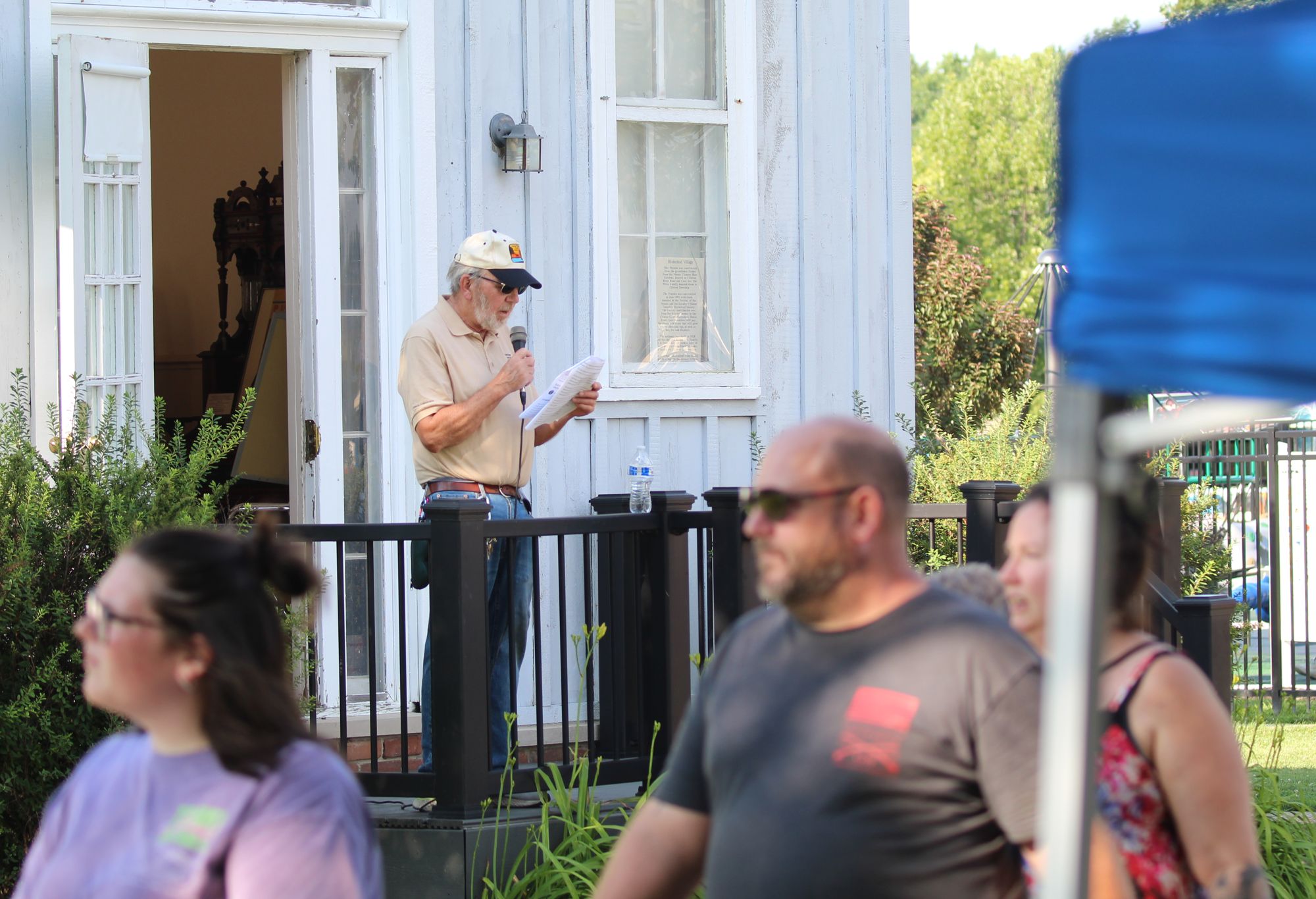
I commend him for getting up there and fighting through microphone trouble, if he was aware of it. He was all but inaudible. He didn’t even make it to the end of Jefferson’s first sentence before the mic cut out entirely. Still he muddled silently along through another 84 words before the mic came back. He was still quiet, though; someone shouted “We can’t hear you,” but he never got any louder. Suffice it to say, little of the Declaration was heard.

James Hungerford reading declaration

The other reason I still haven’t heard the entire Declaration of Independence read aloud is that he only read part of it. He skipped the 27 grievances against the king and instead just paraphrased a couple of them, particularly the one about quartering British soldiers. Afterward, the audience was invited to sign an oversized “birthday card” to America from Clinton Township.

This ended up being somewhat of a letdown, but everybody’s heart was in the right place. It was a beautiful day, and the food truck lineup was genuinely impressive.

Leave a comment →