A year ago today, I unknowingly embarked on a mission to read a biography of every king and queen who ever ruled England, of which there are about forty, if you take the low number.
At the time, I only meant to join my friend Mike in reading a biography of Edward I, who was king from 1272 to 1307. But I liked that particular book so much that I started to wonder, what if I just kept going with Edward II, Edward III…? Conveniently enough, all of these were available as audiobooks from the library.
A year later, I’ve read nine books covering eight kings and started a tenth. Two kings have been deposed, two have gone on crusade, Wales has been conquered and re-conquered, the legend of King Arthur has gained popular traction, longbows and cannons have begun to make battlefields a lot more scary, the Black Death made everything even scarier, the Hundred Years War began and seeds were sown for the Wars of the Roses.
Reading about all these kings in a row has turned out to be a pretty interesting way to learn about history. Each book moves the story forward for however long fate allows. Because a king’s life usually overlaps with the old age of his predecessor and the childhood of his successor, you end up hearing a lot of stuff multiple times, first when one king is old and again when the next is young. I like this; not only does it refresh your memory, but it usually gives you a slightly different historical take, cementing the long and winding story in your head even as it introduces new wrinkles and layers.
Here’s a brief review of all the books I’ve read so far in this series, plus impressions of the one I’m reading now. Use the table of contents below to skip ahead if you wish.
- Edward I
- Edward II
- Edward III
- Richard II
- Henry IV
- Henry V (Allmand)
- Henry V (Mortimer)
- Edward the Confessor
- Harold II
- William I
“A Great and Terrible King: Edward I and the Forging of Britain” by Marc Morris
Read from 7/10/25 to 8/4/25 (3 weeks and 4 days)
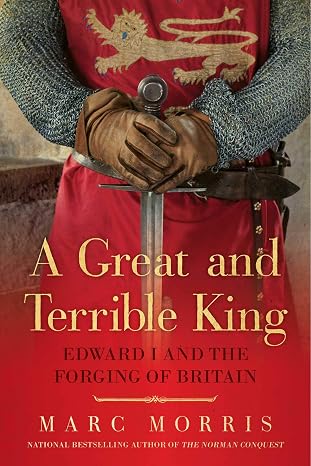
It took me a little while to get into this one, but once I did, I got pretty obsessed. It’s dense in the beginning, during the dwindling years of Edward’s father, King Henry III, who had reigned a long time and had lots of complicated loose threads by the time this book begins. But it becomes clearer and more propulsive once Edward is king, with full freedom of action. The author Marc Morris also struck me as a particularly good, informative writer of history — I’m eager to read another book of his.
This was the story of an adventuresome, mobile king. He’s on his way back from a crusade when he finds out his father is dead and he’s become king, and he proceeds to spend a lot of time leading armies through Wales and Scotland, to the extent that in London a certain lawlessness takes hold in his absence and a wool merchant robs his personal treasure at Westminster Abbey.
By the time Edward died, the consequences of his unsustainable warring were already becoming apparent, and he left a big mess for his incompetent successor, for all of which he must be knocked down a peg.
“Edward II: The Unconventional King” by Kathryn Warner
Read from 8/4/25 to 8/17/25 (1 week and 6 days)
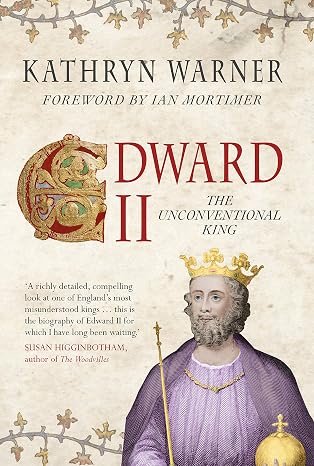
Edward II is a character that I’m glad to have been introduced to. He was born to be king but had zero aptitude for it and no apparent desire to have any. He “preferred hedging, ditching and digging to jousting and fighting,” Warner writes. In war, he was either being horribly defeated by the Scots or cracking down on rebellious nobles. His main interest in kingship was its ability to enrich, ennoble and empower his close companions, especially two “favorites” who may or may not have been his lovers. The first of these was executed by the other nobles, and the other has a civil war named after him. All this led Edward II to be the first English king to be overthrown, and by his wife.
He’s supposed to have somehow died in captivity shortly thereafter, but Warner closes the book with a very interesting chapter outlining clues that Edward secretly survived another 15 years or so in exile. Probably the thing that stuck with me most from this book was her image of Edward living out his days as an anonymous hermit somewhere in Italy, finally getting some peace. He would have been a great Joe Rogan guest.
“Edward III: The Perfect King” by Ian Mortimer
Read from 8/20/25 to 9/3/25 (2 weeks)
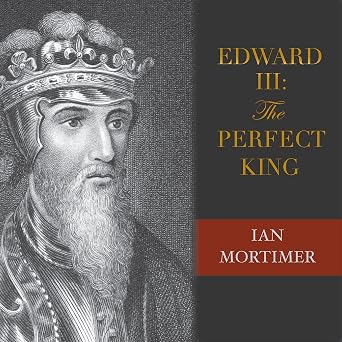
Edward III isn’t much remembered now, but for a long time after his death he was seen as the greatest king England had ever had. The kings who came after him measured their kingliness by his example. He sat on the throne from the time he was a teenager until he was a doddering old man. The Black Death was just one storm that came and went under his watch. Self-consciously tying his own image to the increasingly popular myth of King Arthur, he founded the Order of the Garter, where members could distinguish themselves by dressing in fancy clothes, jousting each other and going on quests. He also won some great ra-ra victories against France, though his actions there may have been somewhat regrettable, kicking off the Hundred Years War, in which France ultimately took back everything Edward had gained.
I liked this book as much as any of these while I was reading it, but I find it difficult to look back on it with any great interest. Edward doesn’t come across as all that complicated an individual, and most of what he did met with success. Even the Black Death hardly pushed him off course; I spent most of this book waiting for it to come, and I hardly noticed when it did.
Like the previous book, this one promotes the idea that Edward III’s father, Edward II, was not killed after being removed from the throne — instead, his usurpers faked his death, and he actually lived out his days as an anonymous exile. At one point in this book, Mortimer pieces together scraps of evidence to conjure a scene of Edward and his officially-dead father secretly reuniting for a brief meeting, arranged through European intermediaries, 11 years into the younger Edward’s reign, in what is now Germany. Edward II is even described being smuggled in under the name “William the Welshman.” As to what Edward II and Edward III may have talked about, Mortimer says “we have only one vague possibility”: Edward I, their father and grandfather, respectively.
It is noticeable that every year for the rest of his life after this meeting, Edward III ordered the wax torches to be renewed around the tomb of [Edward I] at Westminster, this being done on or about the anniversary of his death. It is not possible to be certain, but it seems likely that Edward II had reflected over the years on his confrontational relationship with his own father, and hoped that his son would make amends with the old man on his behalf, if only in the way he was treated in death.
“Richard II: A True King’s Fall” by Kathryn Warner
Read from 9/15/25 to 11/30/25 (2.5 months)
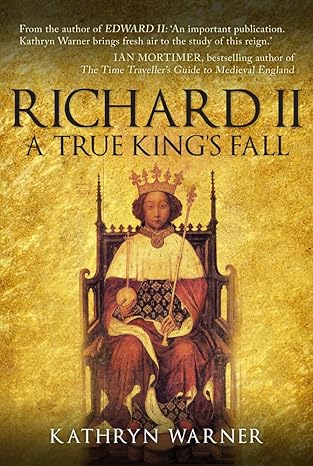
This is where the first big vibe shift of the series happened, and where the story started to get a little complicated. First of all, because the king is no longer named Edward. But this is also the first in this series where the king is not simply the son of the previous king. The randomness of history is starting to jerk the narrative around a little.
Edward III’s much-admired first-born son never lived to inherit the throne, so it instead passed to his weakling grandson, Richard. Richard’s reign went terribly and ended in disaster, with his first cousin Henry driving him off the throne and establishing a new royal dynasty. Not much terribly interesting or memorable happened along the way, at least as Warner tells it here — mostly a lot of domestic squabbling that doesn’t result in much, aside from the rise of Henry.
I was hoping to like this book as much as I liked Warner’s Edward II book, because it’s also about a bad king with the number II, but Richard’s story was a lot less charming, and Warner’s writing seemed a lot weaker, for some reason — more poorly edited, at the very least. I went deeper on that in a full review here.
There’s an almost exactly three-month interval here before I started reading my Henry IV book — the period during which I started this blog. Our trip to West Virginia was the last thing I wrote about before diving back into the monarchs.
“Henry IV: The Righteous King” by Ian Mortimer
Read from 3/1/26 to 5/9/26 (2 months, 1 week and 1 day)
Edward II may have been the first king I actually really liked as a character, but Henry IV was the first one that was really a likeable protagonist. I think part of it is that he wasn’t born to be king, so he’s a bit easier to sympathize with. Mortimer paints him as a good man to whom bad things just keep on happening, and it mostly works (even though it’s still hardly a rags to riches story: like Richard, Henry’s grandfather was also King Edward III, and he was already almost as wealthy and powerful as the king to begin with).
The main thing driving Henry’s story is his rivalry with his cousin, the king of England, Richard II. The two are the same age and grow up closely together but are opposites in every important way: Richard is skinny and unathletic but Henry is constantly jousting, Richard is temperamental but Henry is cool-headed, etc. Things between them get to the point where Richard exiles Henry, then seizes all his property while he’s gone, leaving Henry with nothing to lose in an attempt on the throne. He successfully overthrows Richard, but from there things go wrong at every turn, and it turns out to be one of those particularly human biographies where the whims of fate have other plans.
A lot of this book takes place during the reign of Richard II, and most of its interesting material is there. I actually thought this was a more illustrative and insightful source on Richard than the entire book on him that I described above — perhaps missing a few of Warner’s psychological inferences, but delivering most of the same information with the benefit of Mortimer’s vivid style.
“Henry V” by Christopher Allmand
Read from 5/9/26 to 5/21/26 (1 week and 5 days)
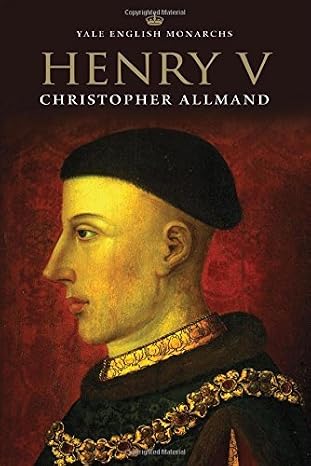
Henry V struck me as the most Warhammer 40,000 king of England. He was a young man who reigned for a short time and spent most of that time striking blows against France that rang down the ages, becoming enshrined in the English mythos. And “whatever his fellow Englishmen might have thought,” Allmand writes, “he did not do it for them or for England. He did it for God.”
This is the main big book on the whole life of this king. It was detailed and felt pretty comprehensive, if a bit dry compared to other books on this list. The concluding note on Henry has the inconclusive, waffly language of a bad scientific paper:
A careful consideration of his whole achievement reveals much regarding Henry’s stature both as man and king. From it he emerges as a ruler whose already high reputation is not only maintained but enhanced.
There’s plenty of raw information here, but Allmand didn’t bring the period to life for me. It was a great source to learn a lot about Henry V, but as a book it was a bit janky.
It’s split into three parts. Part one handles his time as a teenager putting down rebellions in Wales before succeeding his father as king. Part two focuses on the big military campaigns in France that he is known for. I was a bit lost through most of the first part, to be honest, and should probably listen to it again. I had my footing by part two, which reads like a straight-line march to the grave, with chapter titles named simply for the locations of sieges and battles, like title cards in a grim historical movie.
The third part is where the book really came alive for me. It zooms out and becomes a kaleidoscopic analysis of Henry’s overall reign: his family relationships, handling of French civilians, domestic crackdown on heresy-spreading Lollards, his intervention in the Western Schism and even his micromanagement of the quality and dispersal of coinage. This part had a much more expansive feeling and caught me off guard by diving deeply into things not mentioned in the whole-life narrative that preceded it.
From here, instead of moving forward to Henry VI, we stopped to read another book on Henry V. I had really liked both the books by Ian Mortimer described above, and would have liked to read another by him, but his book on Henry V only covers one year of his life, and for this series I’m looking to get the whole life. Since the Allmand book checked that box, and I still wanted to get the Mortimer experience, we made this our first two-book king.
“Henry V: The Warrior King of 1415” by Ian Mortimer
Read from 5/21/26 to 5/30/26 (1 week and 2 days)
This is a day-by-day account of Henry’s whereabouts and activities throughout 1415, the year of his most famous victory, the Battle of Agincourt, which comes three-quarters of the way through the book.
Mortimer describes 1415 as a year in which Henry diplomatically flirted with the French while quietly amassing the army he always intended to wield against them, and then launched it at them to great effect. Meanwhile, the great and good of Europe, including a delegation from England, gathered for the Council of Constance, where they hoped to resolve the “three popes” issue. Along the way, they decided to burn to death a famous heretic, Jan Hus, who’d been invited there under safe conduct. The main thread about the French war is never convincingly connected to this international religious diplomacy thread, but the gathering of the council was still pretty interesting.
There’s also a strange but delightful subplot about a pair of Teutonic Knights who sail from Prussia to collect a debt promised them by Henry’s father, Henry IV. Mortimer gives a daily chronicle of the runaround they got from Henry’s court over a period of about two months before they finally went home emptyhanded.
Something Mortimer repeatedly emphasizes is that Henry was preparing for war even while negotiating with France, buying equipment, sending secret messages, deliberately making unmeetable demands, pawning royal jewels to get war funds. The long swing of military equipment to south of England and then across the water to France reminded me of the drumbeat of news stories about Trump moving ships toward Iran.
Mortimer named Allmand at the end of the book in a refutation of romantic, sanitized views of Henry espoused by other historians.
His principal achievements were due as much to good luck as good judgment. … He plunged England into a potentially endless and unnecessary war for the sake of demonstrating the legitimacy of his dynasty. … He strikes me as a deeply flawed individual, undermined by his own pride and overwhelmed by his own authority. … Only in matters of faith did he significantly outstrip his predecessors; but even this had its downside, especially for those whom he allowed to be burnt at the stake.
Since Mike and I had started this whole thing arbitrarily with Edward I, we knew we’d eventually have to go back to some “first” king. We initially planned to go back as far as William the Conqueror; even though he’s not the first king of England, he seemed like a sizeable enough fork in the road to serve the purpose. Ultimately we decided to go back to the last significant ruler of England before the conquest, Edward the Confessor. He was the model and inspiration for all the Edwards we’d started off with and seemed like a substantial enough character that we wouldn’t want to miss him. And we decided to go back to him now, before we got too far away from this period and forgot the context.
“Edward the Confessor: Last of the Royal Blood” by Tom Licence
Read from 5/29/26 to 6/30/26 (A month and a day)
I’m glad we went back to this king instead of starting at the conquest. I feel like I got some essential insights from this book. This book had a lot to say about how England pushed and pulled against Denmark, Norway and other powers across the water; it made me think of England as just one node in a wider seafaring network, almost like the Greek archipelago. Most importantly it made me reconceptualize William’s conquest of England as less like a lightning bolt that “turned the lights on” in English history but more as the culmination of a long period in which England had had lots of back and forth with multiple foreign powers of similar stature and had already been taken over by a foreign dynasty within living memory.
Compared to the later-era kings we’ve been reading about, the biographical portrait of Edward is limited by the lack of available source material, so I didn’t latch on to Edward much as a character. My picture of him is little changed from the same mythologized image those later kings knew. One detail I liked is that his wife, Edith, was in charge of his wardrobe and overall presentation, and that “when he rode, his saddle and harness glinted with miniature beasts and birds wrought by goldsmiths under Edith’s direction.”
I think the thing that most captured my imagination in this book was a subplot from the later stages of Edward’s life, when he was trying to solve the problem of his childless marriage and uncertain succession. To get a replacement heir, Edward’s court tracked down his nephew, also named Edward, who, like his uncle, had fled into Europe in his youth when the Danes took over England. Along the way he lived in Kiev under the protection of Grand Prince Yaroslav the Wise, who apparently had made a habit of taking in exiled would-be kings and strategically marrying them to his daughters. They ultimately found Edward living in Hungary. By then about 40 years old, he trekked all the way back to England only to die there almost immediately, snuffing out one of the dwindling options for the royal succession.
“Harold: The Last Anglo-Saxon King” by Ian W. Walker
Read from 6/30/26 to 7/5/26 (six days)
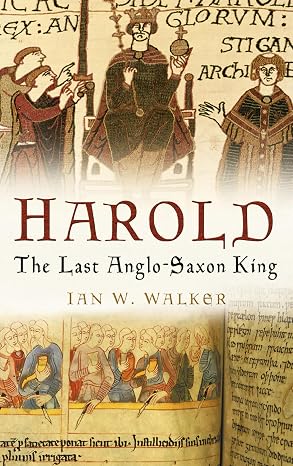
This was another one where I liked the character of the guy. Harold’s story reminded me of Henry IV’s in some ways: two noblemen who managed to get all the way to the top and were not rewarded for it. Harold spent nine months on the throne, then lost one battle and became for all time the man who couldn’t stop William the Conqueror from conquering England.
I can’t account for how I finished this book so quickly; it’s as long as most others on this list. But I did like it quite a bit. The ups and downs of Harold’s family, the House of Godwin, had a vaguely Game of Thrones-y flavor, complete with a twice-exiled evil brother who kidnapped a nun, murdered his cousin and died on the way back from a pilgrimage to atone for his sins.
The book is also effectively a biography of Harold’s father, Godwine, because it starts by going way back in time to show you how he boosted his relatively obscure family into the royal sphere of influence, then worked tenaciously to keep it there. All of this was actually a nice change of pace, and an interesting frame through which to catch up on the immediate pre-conquest backstory.
“William the Conqueror” by David Bates
Started reading 7/6/26
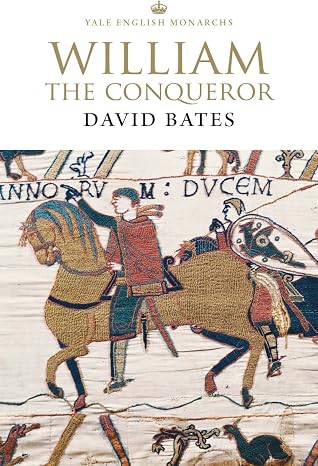
I’m about a third of the way into this book. Like the book on Henry V by Christopher Allmand, it’s a lot of information competently written up but isn’t capturing my imagination as much as others described here.
The book so far has taken place in France, where William is the Duke of Normandy. I wish I could say it’s been more interesting. I’ve been curious to try a French history book comparable to the ones in this series, but there don’t seem to be as many books on medieval French kings. So I’m very much interested to get an up-close look through William’s eyes. But this has had a dry, textbookish feel, stuffed with sentences like this:
The presence among the signa of the diploma confirmed at La Hougue in 1062 of Geoffrey de Chaumont-sur-Loire, the man who regularly appears in the 1060s and 1070s as an intermediary co-ordinating the alliance between the counts of Blois-Chartres and William, and the additional grant to the abbey of Marmoutier made there, must certainly be seen as a reinforcement of the alliance with the counts of Blois-Chartres.
A lot of it so far has been about William maneuvering to gather more and more power in his part of France, most recently by taking over the County of Maine in 1063. Taking that as an example, I wish I could say more about this “County of Maine” and what it means for William to conquer it, but this is what Bates gave me:
For one thing, the long-standing collaboration with Count Theobald of Blois-Chartres, in all probability already deployed in the conquest of Maine, was further reinforced by the marriage of William’s twice-widowed sister Adelaide to Theobald’s nephew Odo. … A more seismic shift involved William’s rapprochement with Ralph, count of Valois, who had also taken over Amiens and the Vexin after his cousin Count Walter’s death. Described as praepotens comes by Poitiers and portrayed by Guibert of Nogent as a mighty warrior, Ralph had a remarkable record for acquiring lordships and had fought against William’s forces at …
I hate to say it, but blah, blah, blah! I’m learning plenty, but not nearly as much as I’d like about the world of Norman France, its history and culture, so I feel a little adrift, drowning in details.
If all goes according to plan, you can get my final verdict in my post about year two on July 10, 2027.
Comments
Leave a comment