I recently made an interesting discovery in Cloudflare’s list of websites linking to Winds Howling. I saw I’d gotten 1 hit from https://pxlarea.com/, a website I’d never heard of before, where blogs of all different kinds are listed on a big grid of “pixels.”
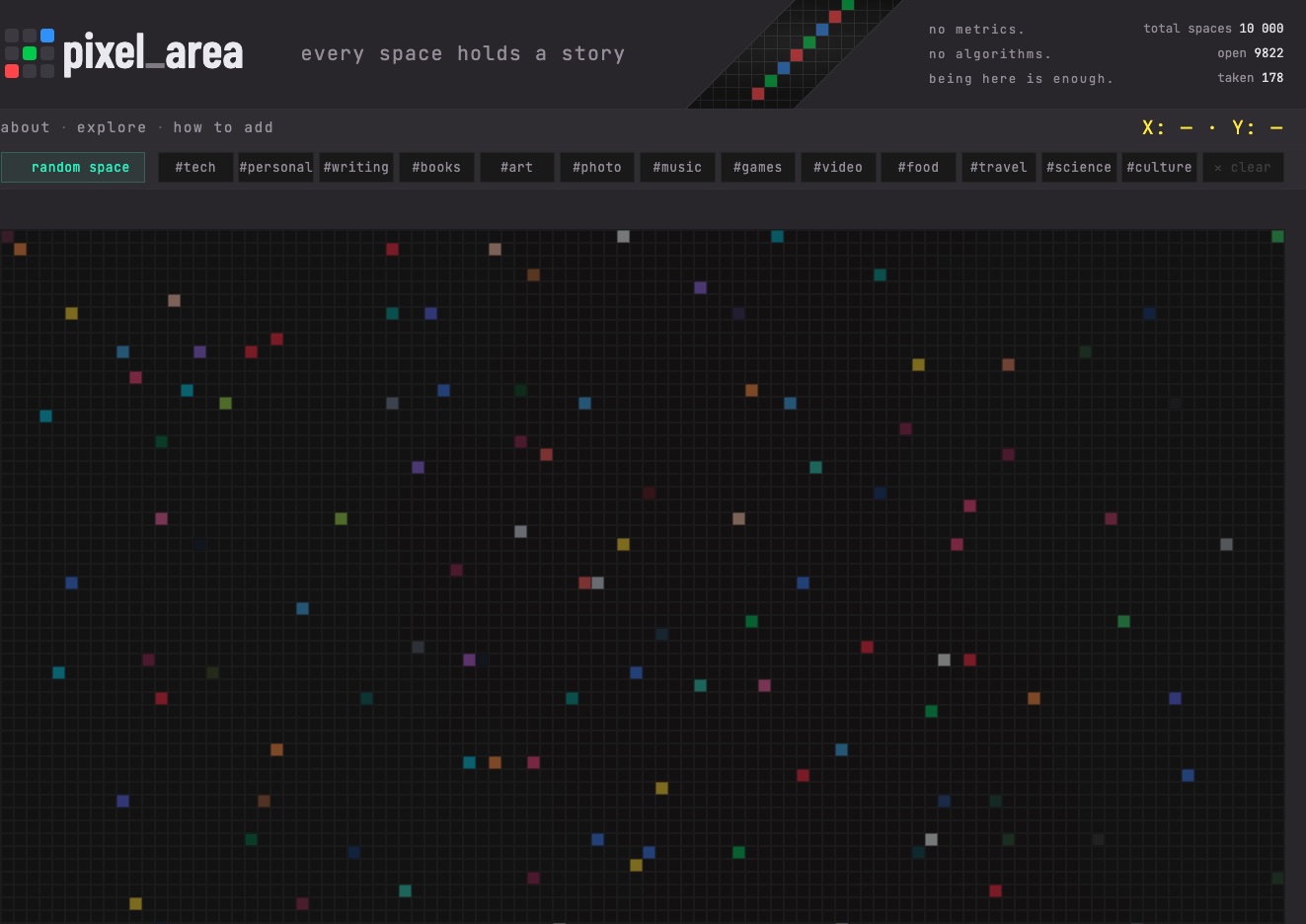
It’s the sort of thing you register your own website on, hoping to draw in a few extra visitors. The About page explains that it’s also about celebrating the DIY internet and knitting together personal blogs that usually exist in a vacuum:
Running an independent site can feel lonely – you publish something, your RSS feed updates, and somewhere another person is doing the same thing without knowing about you. Seeing the map fill up is just a simple way of showing that the independent web is very much alive.
I visited the directory and found my website at coordinate X: 13, Y: 55, where I had the pleasure of reading a vaguely accurate description of my own blog:
Long walks, strange books, good records, old stories, and plenty of things worth getting distracted by.
Beyond the natural amusement of finding myself listed here, I was curious to learn more about whoever had put this together. So I reached out to the developer, who identified himself as a Ukrainian man named Oleh, over 40 years of age, who likes fishing, soccer and computer games. He told me I’d stumbled across the site slightly ahead of his launch schedule, and that Winds Howling was part of the initial batch of sites he’d added to get it jumpstarted.
He said his inspiration for Pixel Area stemmed from “early internet days, when talking to someone at the other end of the wire, or looking at what they had made, left no doubt that this was made by people for people.”
“It is an attempt to light up the paths, to add a small thread that you can pull and end up in an unexpected creative meadow,” he said, “or, let it be, a ‘city of blogs,’ where every cube is someone’s own story, which is damn interesting to explore.”
He nursed the idea for a few years before developing it with the help of AI.
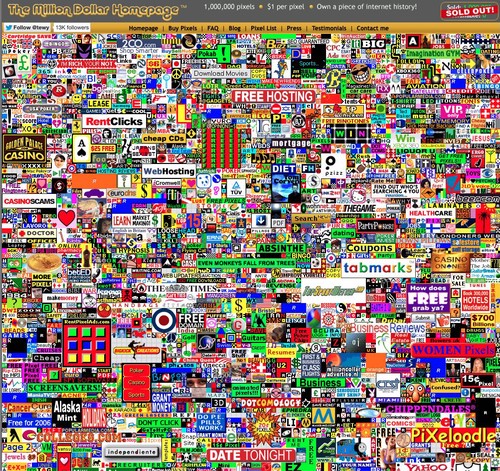
“It had to be a spatial model of exploration, but I could not arrive at a final form. I even thought about a 3D concept, but dropped it fairly quickly because the UI got too complicated,” he said. “Later I came to the idea that it should be a 2D field of separate cells, each one standing for a personal site. And then I remembered The Million Dollar Homepage, which made a lot of noise in its day. That really was a turning point. A field, cells, and basic information when you hover over one of them. ‘Eureka!’”
The “main obstacle” was the actual coding, Oleh said. He described himself as “not a programmer” and “close to IT, but from another side.”
Thanks to AI, that’s no longer as much of a barrier to seeing an idea come to life. The site is largely, if not entirely, vibe-coded. Development began “in chat mode” before moving to VS Code, Oleh said, and “took up nearly all” of his free time for about four months. The codebase now consists of “thousands of lines of vanilla JS, more than two dozen not very trivial PHP scripts, a complex admin panel, registration, tokens, a database, tables.”
He stressed that the AI coding “needed my full involvement” along the way.
“The code is on the AI, but that would be only a part of the truth,” he said. “There is a human in there too. He put his soul into it.”
While writing this article, I did find one genuinely cool website on Pixel Area that I added to my RSS reader: Dave Gauer’s Ratfactor.com, located at X: 58, Y: 49. I enjoyed his diary of late-night Assembly coding on a tiny laptop and his coining of the term “old-timey weekend.” His detailed anatomy of his personal logging system was also highly interesting and got me to crack out a notebook.
Oleh has no blog of his own, though he said he reserved a spot on the field for himself.
“There were a few attempts, but the idea usually faded out pretty quickly,” he said. “I am a technical writer, so most of my time and creative energy goes into my main work. Because of that, I am more of a grateful reader of personal blogs.”
I’m not the only one writing about my site being added to this grid. Here are some other bloggers’ thoughts on Pixel Area:
Organising personal websites spatially seems like a strange idea (although there’s a list view available too). And ‘pixel’ seems to be a strange name (at my desktop resolution, my ‘pixel’ comprises… 169 pixels). … I’m undecided on this one. But, as always, I love when people do cool, random and experimental stuff with the Web!
— Dan Q
I am heartened that people are still making such things. Whimsical but useful and offered without fanfare or price.
For myself, I admire the idea of the site and the spirit behind it, but I don’t think the colored pixels are very enticing to explore, especially on mobile. Until you hover over them (which of course, you can’t do on a phone), they’re just anonymous blank squares. It’s arbitrary which square to hover over; you may as well just use the “Random Space” button and save yourself the energy of moving the mouse. But I’ve found the hit rate of interesting sites to be pretty high, so it is doing that part of its job well.
Closer inspection of Pixel Area’s grid reveals the existence of “districts,” with names like Vector Fields, Cache Hollow and Binary Ridge. Oleh said this “is the groundwork for the next stage of Pixel Area.”
“Let us keep a bit of intrigue here. Ask me again in a few months,” he said, while encouraging new people to “settle in any district you like.”
Comments
Leave a comment