Recently I became curious about Cady’s Corner, a village that used to exist around my area in the 1800s, but has since faded out of existence. I went looking for old records about it and the person it was named after, Chauncey Goodrich Cady, and along the way, I got in contact with Katie Decker, the granddaughter of the present owners of a house built by Cady. She provided me with a PDF of historical information she’d gathered, including a typewritten biography of Cady that doesn’t appear to have been published online before.
I transcribed it for your convenience below, including the footnotes. Here’s a link where you can download the original version Katie provided me with.
The manuscript was “compiled and edited” by a Michael C. Buckley, but I haven’t been able to learn yet who he was or when he made this. I’m also not sure what parts Buckley wrote, because I recognize multiple passages that he lifted from other sources without citing them. The bit about Cady’s Corner being “a small settlement composed chiefly of German farmers” comes from an 1882 book, “History of Macomb County, Michigan” by M. A. Leeson, and Buckley’s description of Chauncey Cady’s “keen wit and humor” comes from the later historian Robert F. Eldredge’s book, “Past and Present of Macomb County, Michigan.” Sometimes Buckley contributes additional details: when he lifts Eldredge’s mention of a store and tavern that existed in Cady’s Corner, he adds that the store’s owner was named Mr. Floyd Kimball and the tavern was called Empire House. He also sometimes polishes antique language, updating Eldredge’s “drawing card” to “attraction.”
I’ll be coming back soon with more in-depth posts about Cady’s Corner, but for now, here’s a document I’ll be referencing later.
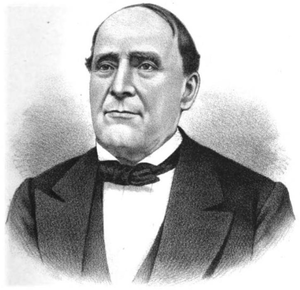
HON. CHAUNCEY G. CADY
Compiled and Edited
by
Michael C. Buckley
Probably the most notable person in Clinton Township between the years 1820 and 1880 was Chauncey G. Cady.
One of the wealthiest and most influential citizens of the township, Chauncey Cady took a leading and active part in one after another of the stirring events which led up to the actual settlement and political organization of Clinton Township. Especially noteworthy was his loyal participation in the Republican Party, after apparently having been disillusioned by the old Jackson Democrats.
His enthusiasm and patriotism knew no bounds, and he was lavish of his time (and money?) in defense of his country’s freedom. Today, more than 160 years after his birth, we still enjoy the fruits of his efforts.
Chauncey Cady was born in Otsego County, New York, on August 20, 1803, the son of Joseph and Lucy (Hutchins) Cady.
His mother and father were a brave, pioneering couple. His father, Joseph Cady was a native of Windham (Windom), Connecticut, and Mrs. Lucy (Hutchins) Cady, a native of Killingsley, Connecticut. Soon after they were married, the Cadys moved to Otsego County, New York, where Chauncey was born. They moved again, to Buffalo, New York, in 1805 (06?).
Joseph Cady, responding to the irresistable beakon of adventure, left Buffalo, on a land exploratory expedition in 1807, and not returning was traced to many prominent villages southward, and was ultimately found to have died in Cincinnati on his journey back home.
Mrs. Cady then moved her family — Chauncey, Horace (Henry?) and Lucy — to Batavia Township, in Genesee County, New York, in the latter part of 1807.
Chauncey Cady’s education began in the district schools in his native state for about three years. Previously, at the age of six years, he was apprenticed to a farmer named Shubal Dunham, of Genesee County, with whom he stayed three years.
In 1809, he returned to his home in Batavia, and for the three successive years labored on the farm during the Spring planting and Fall harvest, and attended school during the Winter. That this training was effective is shown by Chauncey’s successful participation in politics when he was only 17 years old.
After three years of raising her family as a widow, Mrs. Cady met and married Thomas Ashley, in 1810.1
From 1814 to the date of his coming to the Michigan territory, Chauncey assisted as clerk in a hotel, then kept by his step-father, Thomas Ashley.
In 1820, as stated in the Pioneer record, Chauncey came to Mt. Clemens and entered on that active life which has marked his residence here. In 1833, he moved to his original farm in Clinton and Sterling townships.
The Hon. Chauncey G. Cady founded Cady’s Corners, located at Utica Road and Moravian Drive, and was the namesake of the Cady (now Einstein) Elementary School, located on Miami Road, between Fifteen Mile Road and Moravian Drive, east of Utica Road.
In 1833, Chauncey settled on a farm which is now called Cady’s Corners, (est. c.1834), about four miles south and west of Mt. Clemens, and was a prosperous farmer there for many years.
He built a house in each township; the one in Clinton he sold about 1870 to John and F. Priehs, and held the residence in Sterling on Moravian Drive.
The original Cady property was bounded by Moravian Drive on the west, Fifteen Mile Road on the south, east to Garfield, and north to Moravian Drive, just south of Sixteen Mile Road. Part of that area now contains the Moravian Meadows subdivision, Stacey Manor subdivision and the Shangri-La Drive settlement.
The Village of Cady, or Cady’s Corners, was a small settlement composed chiefly of German farmers and their families, dating from 1834. It was on the Clinton River, in the center of a rich agricultural region — this area shows some of the earliest agricultural improvements begun after the War of 1812 — about seventeen miles above Detroit, five southwest of Mt. Clemens, the county seat, and near Fraser Station, on the Grand Trunk Railway, to which depot goods were shipped. Fraser had a German Lutheran Church (St. John’s) and common school (the old Fraser Elementary School, now one of the Fraser Junior High schools).
Cady’s Corners was the postoffice of a settlement that grew up around the crossing of the Detroit and Utica Plank Roads (now simply, Utica Road) and the River Road (Moravian Drive) from Mt. Clemens, through the Village of Frederick (Hillcrest Country Club) to the southwest part of the county (Moravian Drive and Cass Ave.)
It was so named because the residence of Chauncey G. Cady was nearby. It had, for years, a store, managed by Mr. Floyd Kimball; a tavern, called the Empire House; and for some time a milk station, which had afforded an additional attraction for the surrounding farmers.
Cady’s Corners seems to have been a rendezvous for many who, after recuperating and reconnoitering, started on expeditions to other parts of the county, or to the counties around. Seven men had gone from Cady’s Corners, as early as 1825, to make a beginning at Romeo, Michigan.
The Corners were apparently occupied with dwelling houses and business offices, and an embryo village of log and framed buildings, were known to have existed there before 1830. There were probably twelve to fourteen families there at the time, though many more travellers had made a temporary residence there.
As previously mentioned, Chauncey played an active part in local politics. Prior to 1826, he became a member of the Macomb County militia, under Gen. Stockton, from ages 23-26. He was paymaster of the command and mustered out of the regiment in 1829, with the rank of Major. His military outfit alone was present during the Toledo War.
Chauncey married Miss Catherine Gerty of Harrison Township in 1829, as given in the marriage record. Catherine died August 27, 1865, at the age of 52. He then married Miss Mary J. Royce, October 22, 1867. Mrs. Chauncey (Royce) Cady died at the age of 79, in 1899.
At 31 years of age, he served as “Collector” for Clinton Township in 1834, about the time Cady’s Corners became a Village officially.
He was elected Supervisor in 1841, and re-elected in 1845. While Supervisor, he held the office of Justice-of-the-Peace for Clinton Township from 1841 to 1849. Also in 1845, he was elected by the Republican Party as Representative to the State Legislature and took his seat.
In 1849, he was re-elected, and entered the State Legislature of 1850-51, this being only the second session held in Lansing. He was also elected Justice-of-the-Peace for Sterling Township in 1865, but because of delay on the part of the Township Clerk in making returns, did not qualify. He was elected County Drain Commissioner, and filled the duties of that particular office for six years without difficulty and in a manner satisfactory to the Supervisor’s Board.
Mr. Cady was an old Jackson Democrat up to 1854, at which time he joined the Republican Party when it was organized in 1854, and took a lively interest in political work, making campaign speeches and presiding at public meetings. He was very active in all pioneer gatherings, where his unfailing fund of anecdotes and keen wit and humor made him most welcome.
He was a member of the Convention which nominated Alpheus Felch, instead of John Barry, for governor, also of the State Convention in 1880 from the Macomb County Senatorial district, as well as of several county conventions.
The Macomb County Pioneer Society was founded in 1871 and collapsed, at Washington Village, March 22, 1881. On March 26, 1881, it was reactivated and Chauncey was elected the first President of the Pioneer Society of Macomb County; his brother Horace served as one of the vice-presidents.
One of his sons, Lewis Cady, was a well known livery stable keeper at Mt. Clemens, and later served as a sheriff. Several other children resided in Detroit.
A nephew, L. Stanley Cady, son of Horace Cady, was a prominent druggist in Mt. Clemens, with the firm of Cady-McCoy.
Established in 1942 by Stanley and his partner, George McCoy, the firm prospered despite a disasterous fire in 1944 that forced relocation of the business until 1947.
In that year, Cady-McCoy opened their modern new store at their present location at Gratiot and Cass Avenue.
On July 12, 1962, to help celebrate the occassion of their 20th anniversary, the firm offered sodas at the 1942 price of 15 cents, for three days. Also offered were $500 in prizes, special gift checks and a variety of bargains.
The Hon. Chauncey G. Cady, one of the oldest inhabitants of Macomb County, went to live with his daughter in Detroit c.1890 and died there at 174 Alfred Street, Detroit, December 10, 1893.
The funeral was held from his daughter’s residence on Alfred Street, Wednesday morning, December 13, at 11 o’clock and from the Methodist Episcopal Church in Mt. Clemens at 2:30 p.m., the same day, out of consideration of his host of friends in Macomb County. He was a little more than 90 years of age.
Chauncey’s step-father, Thomas Ashley, referred to earlier, was a native of Windom, Connecticut, moving afterward to Batavia, Genesee County, New York. About the year 1810, he became acquainted with the Cady family of Batavia Township.
Mrs. Lucy Cady married Mr. Thomas Ashley in 1810, three years after the death of Joseph Cady, in 1807. The family was then comprised of Mrs. Lucy Ashley, formerly Mrs. Lucy Cady, her sons Horace and Chauncey G., and her daughter Lucy. With the exception of Horace Cady and Alfred Ashley, they moved to the Michigan Territory in 1820.
They set out on their western journey, and after an adventurous pilgrimage through the wilderness, arrived at Detroit, proceeded to Pontiac, and back to Mt. Clemens, where Mr. Ashley built the first entire frame structure erected in the village if we except the frame addition to the Clemens House, built by Col. Stockton, and the little office of lawyer Ezra Prescott. Miss Lovinia Russell, afterward Mrs. Ezekiel Allen, accompanied the family. Mrs. Joseph Cady died eighteen years later, on the Cady homestead, on Moravian Drive, in 1838.
When Thomas Ashley came from Batavia, New York, with Lucy and the Ashley and Cady children, he bought about 20 acres of land in the northwest part of the village, (Joy Blvd.), where Mr. G. B. Van Eps lived, and he built the frame house mentioned above in Mt. Clemens on the corner east of the bank, at Crocker and Ulrich, in which he kept a hotel. It was the first hotel to be built in Mt. Clemens.
The Ashley (Cady) family lived in an old log house until they erected the frame building, referred to above, in 1823.
Thomas Ashley was a successful farmer and one of the early lawyers of the county. He practiced law in New York and also after he arrived in Mt. Clemens. He was admitted to practice law in Mt. Clemens, in the 16th Judicial Court, July 11, 1820. He was “one of the boys” of the village of Mt. Clemens, and took part with them in all the merry meetings of the villagers, as well as in the more serious meetings of the business community.
Acting in the triple capacity of landlord, lawyer, and farmer, he found plenty to occupy his time, and during his brief life gave the village an example of untiring industry. He was City Clerk before he died, October 8, 1827, at which time his son Alfred was elected to his father’s position at a special meeting.
A year later, in May, 1821, Horace H. Cady and his step-brother, Alfred Ashley, arrived in Mt. Clemens from Genesee County, New York. In 1821, Chauncey, and Alfred Ashley, erected the old saw-mill on the North Branch, two miles west of Mt. Clemens, better known as the Haskin’s Mill.
In 1821, Alfred Ashley, son of Thomas Ashley, and Horace Cady began clearing on the North Branch, at Haskin’s (then called Ashley’s) Mill. That year Horace Cady, a large-framed, erect, and powerful, with strong noble features, always a striking figure, plunged into the woods and dealt some of the first blows to the surrounding trees.
Horace and Alfred built a dam and erected a saw-mill, which Horace ran through the following Winter. In the Summer of 1822, they made an addition sufficient to receive one run of stone for a grist-mill.
During the Winter of 1825, Alfred Ashley was married to Euphemia Atwood on January 24, by Justice-of-the-Peace, Henry Clossen. Five months later, Horace Cady was married to Susanna O’Connor, June 9, 1825, by the same Justice, Mr. Clossen.
In 1828, Alfred Ashley, in the manner of his father, erected a hotel on the site of Fluemer’s Mill. It was a hostelry for a long time and was favorably known as the Phelps House. It was known and casually spoken of as Ashley’s Tavern before it acquired the more decorous name of Phelps House.
In 1845, Alfred moved into Chesterfield Township and later founded the Village of Ashley (now New Baltimore), and for a long time, and until his death, September 7, 1857, was its most prominent citizen. His grandson was still a resident of that Village until his death recently.
In 1829, Horace Cady erected a building, which by several additions had grown into the Empire House at Cady’s Corners. The Empire House has been described by residents as a “large, respectable, hotel.” Until recently it was located on the northeast corner. The Corner was not then as prominent a place as it has since become, for the Shelby2 (Utica) Road was then a fact lying in the future, and the road (Moravian Drive) to Frederick (at Moravian Drive and Cass Avenue) lay by the place lately owned by A. C. Smith, onward to the bank of the Clinton River near the residence of A. Morross, and up the river to Frederick (Hillcrest Golf Course).
Before the War of 1812, and for some time thereafter, communication between Cady’s Corners and Frederick was mostly by water. The river was the most expedient road to the Ashley (Haskin’s) Mill, when it was in operation at Frederick.
Like his brother Chauncey, Horace was involved in minor politics and in later years was appointed Commissioner and helped to lay out the highway from Mt. Clemens to Sault Ste. Marie by way of Romeo, Lapeer, and Saginaw.
The Cady name is all but forgotten in the Clinton Township area now. The family is dead; the Village of Cady expired in toto, as most other smaller villages of that time did, viz. Frederick, New Gnadtenhutten, Ashley, etc.; and the Chauncey Cady school has been successfully disguised — with demolition, renovation, additions — as the Einstein Elementary School.
There’s one orphaned footnote (#2) that I couldn’t find cited anywhere in the text, so I’ll just put it here: “Mr. Haskin, an early settler of Mt. Clemens, died there in 1821, and his was the first body to be interred in (what is now) Clinton Grove Cemetery. It was then a forest, and Horace Cady was among those who began the clearing for that purpose. Previous interments had been near the site of Jo Batty’s house: No trace of them remains.”
-
An Interesting discrepancy appears in one account describing the relationship between the Atwood family and the Cady family. In one account Mrs. Cady married Thomas Ashley, and in another, there is a detailed description of her marriage to Peter Atwood and their trek to Michigan with their families. Mr. Atwood and his family have played no small part in the history of this locality. His wife was the widow of Joseph Cady, a native of Windham, Connecticut, who died in Cincinnati in 1807. With Mr. and Mrs. Atwood came three of the children of Joseph Cady, viz., Chauncey G. Cady, Horace H. Cady and Lucy, who afterwards married Silas Halsey. Peter Atwood was apparently acquainted with the Cady family in Genesee County, New York. Three years after the death of Joseph Cady, Peter married Lucy Cady and brought the combined families to the Michigan Territory. Peter had children by a previous marriage. They started for Michigan in the Spring, but heard it was very sickly here, and went into Canada, where he put in Spring crops, and left his family to spend the Summer, while he came to Macomb County to look for a home for them. At that time there was but one steamboat on Lake Erie—the “Walk-in-the-Water.” Families migrating westward, furnished their own motive power. He started on the farm long known as the Edgerly farm, and later as the Israel T. Parker farm. He slashed twelve acres of timber that Summer, cleared five, and built a log house, which stood until 1833, when it gave place to their present dwelling. In the Fall of that year his family came through Canada. They drove their cattle, sheep, and hogs. Mrs. Ashley (In other accounts, Mrs. Atwood. This error suggests that this entire account has been confused with the Lucy Cady-Thomas Ashley description of her second marriage. All his children, as well as his step-children, married here and they and their families are important factors in the county’s history. One daughter became Mrs. James C. Edgerly, and lived on the farm just referred to. One son of Peter Atwood, Sylvester F., was for years one of the prominent lake captains whose home was always at Mt. Clemens, where he died in 1888. His son, S. Park Atwood, was a resident of Detroit. The oldest son of Peter Atwood was Hiram, who married Fanny Marie Cook, May 3, 1825, with Justice-of-the-Peace Clossen officiating. For many years after 1822, Peter was the owner of the Atwood Farm in section one of Clinton Township (presently Joy Blvd. and area east of Gratiot), the father of Mrs. Jonathan Widrig of Mt. Clemens, and grandfather, through Hiram Atwood of Mrs. M. M. Smith, Mrs. F. J. Hole and Mrs. A. H. Kent, all of Mt. Clemens. Of the step-children of Peter Atwood, Lucy (Joseph’s daughter) married Silas Halsey, the one-time tavern-keeper of the village. Chauncey Cady was an active pioneer after whom Cady Corners was named, and Horace H. Cady, who long lived in Section 35 (the area between Groesbeck and Gratiot, South of Hall Road), later owned by his son, John C. Cady. His step-son Chauncey Cady was very active in his later days in all pioneer gatherings. Louis T. Cady, the ex-sheriff and a former Alderman of Mt. Clemens, was Chauncey’s son. Chauncey’s brother, Horace H. Cady, was long a prominent citizen of Macomb Township, its supervisor several times. He married Susan Connor, of the John Connor family, and he and his wife each lived to be upwards of 80 years of age. Peter Atwood died in 1826 and the farm was later sold to James C. Edgerly who made his home there until his death, November 13, 1856.) took the supervision of the stock; drove to a hotel; and, if there was no landlord or groom about the premises, helped herself to all they needed, and called for her bill when the tardy landlord appeared—an example of energy worthy of imitation. They came by the lake shore from Detroit, and reached here in December. There was no road to their house. They kept the direction by grazed trees. Mr. Atwood died in 1826. ↩︎
-
There are conflicting uses of “Shelby Road.” In some accounts it is described as Cass Avenue. ↩︎
Comments
Leave a comment