I recently finished the latest book in my series of biographies about all the kings and queens of England. For the life of Henry IV, who ruled from 1399 to 1413, I picked “Henry IV: The Righteous King” by Ian Mortimer.
This was one of the more interesting and unusual ones I’ve read so far. It’s told as the story of a basically virtuous and admirable guy whose reign is never quite allowed to flourish. He’s as promising a candidate for king as could be wished for, but he spends his 14 years as king running from one internal crisis to another until he finally expires.
Henry starts out as the richest young man in England, heir to the most powerful nobleman short of the king. He makes a name for himself with lots of knightly jousting, crusading with Teutonic Knights, and going on pilgrimage to Jerusalem. But he falls out badly with King Richard II — also a young man, the same age as him, but a bad, unpopular ruler lacking Henry’s steady, good-at-everything competence. Richard temporarily banishes Henry from England, then once he’s gone, he strips him of his inheritance and exiles him for good, leaving Henry with little choice but to risk it all in overthrowing Richard. He sneaks back home and starts making deals and amassing forces. He captures the panicking and ineffective Richard pretty easily and is swept to the throne in an ecstasy of popular support.
Then the gears shift. His reign is immediately swamped with internal revolts, whack-a-mole military campaigns against Scotland and Wales, and lots of annoying back and forth with Parliament. There were consecutive years of crop failure, feeding a rise in lawlessness and disorder throughout the country. All his energy was needed just to keep his head above water. As king he accomplishes virtually nothing of consequence.
Henry’s reign withered away along with his health, and his son, the future King Henry V, increasingly took charge. His main health problem seems to have been some sort of “skin ailment,” which flared up with a “burning” sensation in 1405 and may have been present decades earlier. It developed into a “wasting disease” that basically left Henry a zombified corpse, or so Mortimer makes it seem. Quoting a well-informed medieval Welshman, he writes:
Henry suffered ‘an infection’ which resulted in ‘festering of the flesh, dehydration of the eyes, and rupture of the internal organs’. … In this ‘festering of the flesh’ it would appear likely that Henry’s skin disease had grown progressively worse, from his burning skin … to a more general degradation of his lower body. … He was an invalid, dependent on others and in agony as his lower body, quite simply, rotted away beneath him.
What made Henry’s story so interesting was the sense of cosmic injustice hanging over him. It seems like he was a good man and played his cards well, but he was rewarded with a frustrating, fruitless time as king and a lasting reputation as a usurper. But it seems like the stage should have been set for him to be one of the greats. He seems to have been a genuinely admirable person — “one of the most courageous, conscientious, personally committed and energetic men ever to rule England,” as Mortimer puts it here. His overthrowing of Richard II was hailed as the coming of a savior at the time, and he set out to be a model ruler: “pious and conservative … merciful to his people, leading them in victorious battles overseas, maintaining peace at home, working with parliament and facilitating the economic prosperity of the nation.” But making England great again was easier said than done, as Mortimer explains:
This was a form of kingship whose most vivid colours had already begun to fade. An early fifteenth-century king could not hope to impose spiritual orthodoxy on his people and avoid controversy. … Similarly, it was increasingly hard to equate overseas warfare with economic prosperity at home. Overseas wars cost a lot of money, and that meant direct taxation. Victories over the French, Scots and Spanish still had their place (as shown at Agincourt in 1415), but such conflicts were difficult to justify economically. The mechanics of war were changing too, with guns and longbows replacing the massed charge of knights, so that chivalry had lost much of its purpose. Lastly, the relationship between king and parliament had changed. Whereas Edward III had been forced to work closely with parliament, Henry unwittingly compromised himself at the outset, in declaring his objective of cooperating with parliament as a matter of principle (a position from which he later had to withdraw). Therefore, although Henry’s vision reflected the greatest form of kingship then known, it was already out of date. Even if he managed to satisfy a few or all of his competing priorities for a short while, he could not continue to do so for long.
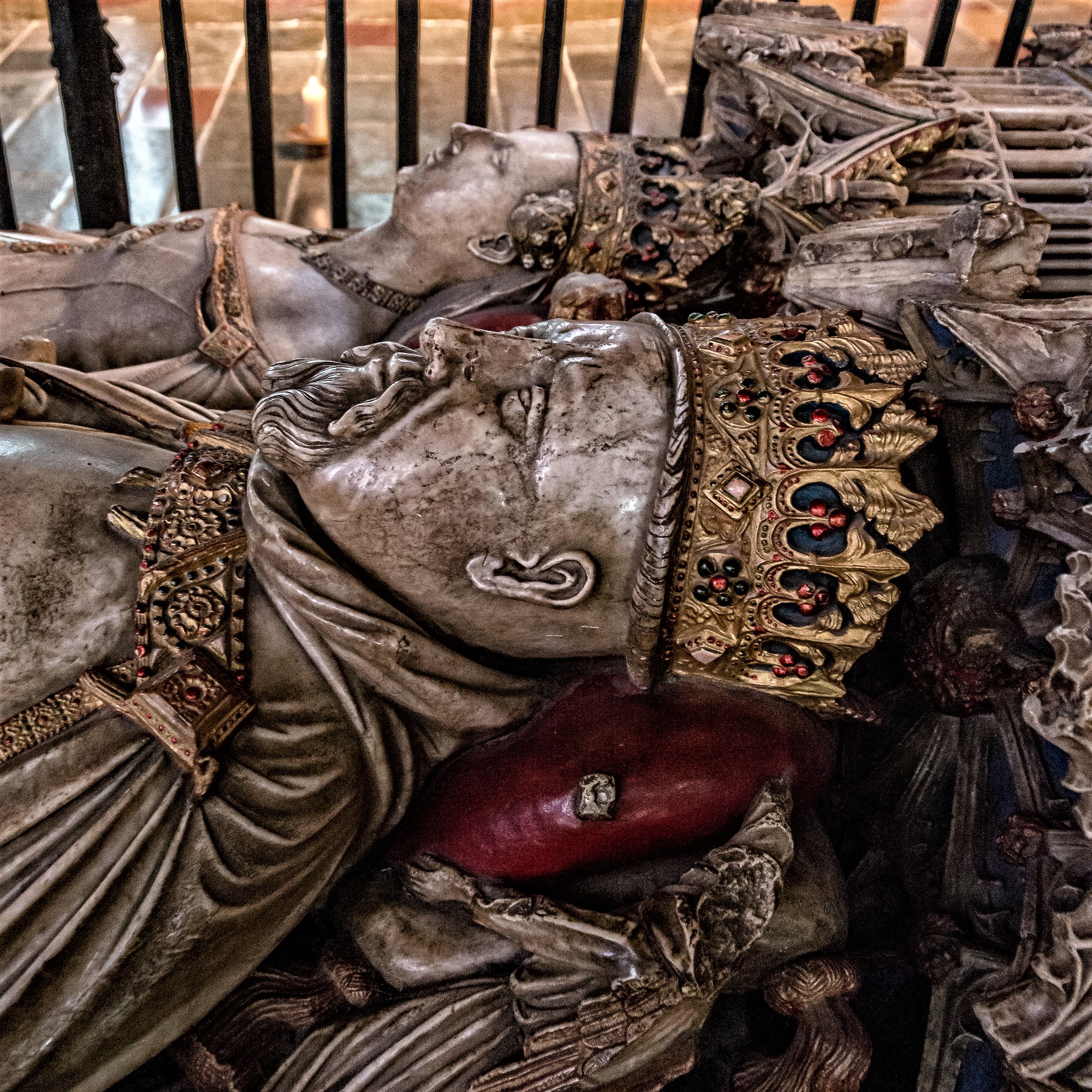
Even if his reign didn’t amount to much, Henry himself was pretty interesting as an individual. The book presents a man with two seemingly contradictory, but equally well developed, sides: the brave, chivalrous knight and the patient, quietly calculating intellectual. He participated in at least 500 individual rounds of joust before he became king, as Mortimer describes in one of the book’s more memorable passages:
In full armour and mounted on a war horse, he charged straight into another object of a similar weight (the man, armour and horse combined weighing more than half a ton), with all the pressure of the charge focused on the point of the lance, at a closing speed of more than forty miles per hour. The strain on the body, including the brain, of such an impact would have been considerable, way in excess of the being-hit-by-a-twenty-pound-hammer effect which modern boxers experience. It is therefore reasonable to wonder whether he suffered from the condition which affects some boxers in retirement, known as ‘punch-drunk’.
On the other hand, he was “probably the nearest to an intellectual among all the medieval kings of England.” He was “a man of reason: inclined to logic and justice more than extravagance.” He ordered “a magnificent study to be built … with cupboards specially designed to house his books.” He wrote fluently in multiple languages. He comes across as an almost modern mind, with “an intellectual self-confidence matched by very few of his contemporaries.” Mortimer makes much of Henry hanging out at the University of Paris during his exile, engaging in debates about the hot-button issue of the day: the existence of two opposing popes, effectively dividing Europe into rival Christian camps.
Mortimer at one point acknowledges his picture of Henry seems “too good to be true.” He seems to be a man with no negative personal traits: he’s strong, brave, determined, intelligent, charming, well-read, strategic, honest, loyal, family-oriented and basically benevolent. But this was a king constantly fending off rebellions, facing ever-increasing scrutiny from Parliament, and never getting anything done. So what went wrong? When Mortimer tries to put a finger on it, it’s only that Henry had too much of an upside — that he was too generous, or too trusting.
His concept of mercy was pushed to the limit, and then beyond, with the inevitable result that he was forced to take more direct action against unrepentant rebels, making his initial promises of mercy appear false. His own standards of duty and loyalty were so high that he expected more of his leading subjects than they were able to give. … Most of all, he wanted so much to be a good king—attempting to please everyone all the time that he inevitably displeased some. In no aspect of his rule is this clearer than his failure to cope financially. His natural generosity and his loyalty to his friends meant that, after 1399, he became generous to a fault, giving away far more than he could afford. When the implications of this were made clear in parliament, he was reluctant to do anything to remedy the situation. He would rather tax the anonymous masses than take away a grant from a loyal supporter.
Mortimer puts forward two original arguments about Henry. The first is that after overthrowing Richard II, Henry ordered his murder. At the time, domestic propaganda had it that Richard starved himself; the French spread a story about a violent murder, later made famous by Shakespeare. According to Mortimer’s scrutiny of the ancient records, Richard was indeed “killed on Henry IV’s instructions,” entirely possibly by forced starvation, but he’s not exactly sure how. He offers more than 2,300 words of careful reasoning that may be convincing, if you agree with his estimation of what is “simply not credible” and what “there can be no doubt about.”
Mortimer also attempts a rehabilitation of Henry’s legacy as a “usurper.” I won’t pretend that prior to reading this book I had any conception of Henry IV as a usurper or otherwise. But it turns out to have been a key weakness of his reign from the beginning: no matter how virtuous he was or how well he ruled, he was still the guy who overthrew his predecessor, and that just sort of creates a stink cloud around you. His entire existence as king was arguably an affront to God and courting divine retribution. Even so, Mortimer writes that if it was a usurpation, “it was the most popular usurpation in English history.” Parliament cheered him onto the throne with genuine enthusiasm, and “at the time, men called him a savior.” For the “usurper” reputation, Mortimer points the finger at a few historical forces, including being overshadowed by the military successes of his son, King Henry V. But his strongest point is that the example of Henry’s path to power wasn’t one that later monarchs were keen to remind people of. The “usurper” framing was enshrined in Shakespeare plays and passed down to the modern day.
Mortimer is a great writer, the best at bringing the medieval world and its inhabitants to life out of any of the English monarch biographers I’ve read so far. He’s great at cultivating a sense of drama and has a good sense for keeping a reader hooked. He has a knack for conjuring up a living scene the way you might expect in fiction – drawing you into the candlelit room where a monk is unrolling a chronicle, for example – and using that as an entryway to the usual historical narration. This book was also a far better book on Richard II than the actual book I read on Richard II – the first half is basically the full reign of Richard II from Henry’s perspective and has a lot of insightful character nuggets about that other interesting king.
Comments
Leave a comment