"The Silver Chair" by C.S. Lewis
I recently finished reading The Chronicles of Narnia by C.S. Lewis for the first time. Over the years I’ve heard about the series being some kind of Christian allegory. Christian overtones and occasionally outright references were pretty obvious from the outset, but I felt it really kick into gear in the fourth book, “The Silver Chair.”
The preceding books had splashes of detectable Christianity here and there: Aslan is like Jesus, the main kids are referred to as Daughters of Eve and Sons of Adam, etc. It was enough enrich the story with another layer of potential meaning and get me thinking, but not so much that it felt like it was the whole point. In “The Silver Chair,” and really only in “The Silver Chair,” the balance teetered.
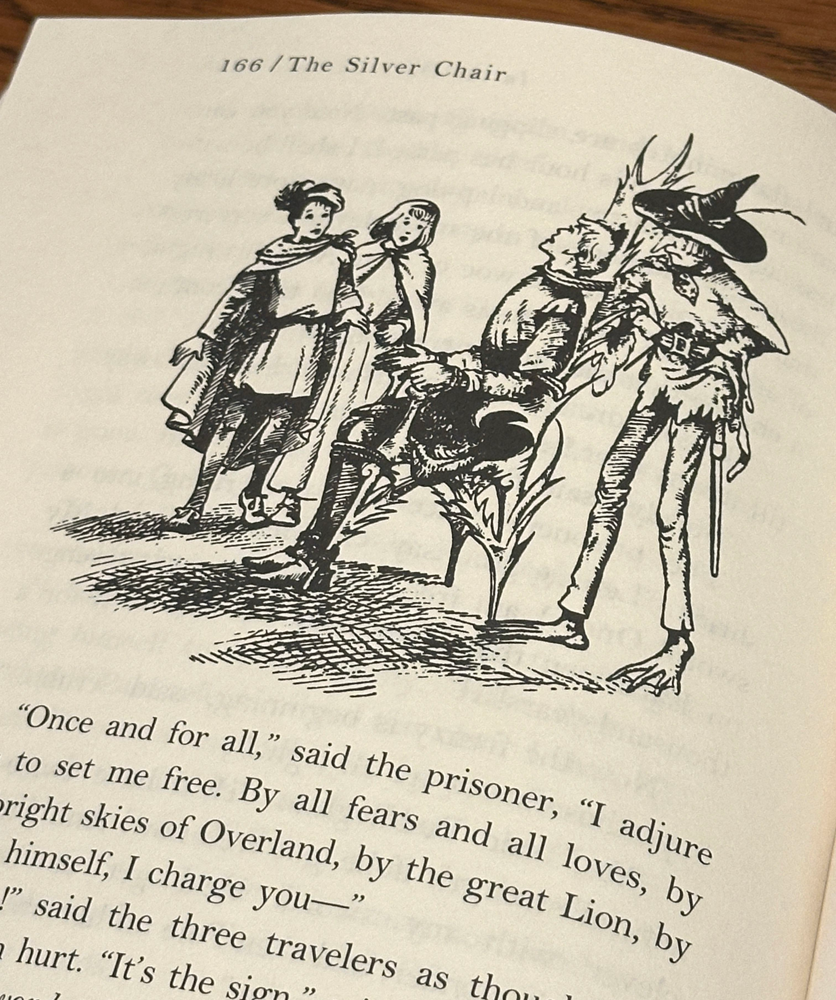
It started to feel like Christian themes were being used less to evoke some kind of spiritual meaning and more to instruct me in right and wrong. The most obvious thing was the author repeatedly breaking the fourth wall to tsk-tsk the way things are done at the school the main characters attend, which is called “Experiment House.” At Experiment House, kids don’t learn Bible stories, girls aren’t taught to curtsey, the principal is a woman, and presumably every other class is about critical race theory. The author pulls us aside several times to let us know what he thinks about all this:
“If I find you’ve been pulling my leg I’ll never speak to you again; never, never, never.”
“I’m not,” said Eustace. “I swear I’m not. I swear by—by everything.”
(When I was at school one would have said, “I swear by the Bible.” But Bibles were not encouraged at Experiment House.)
This started right at the beginning of the book and popped up now and again. Everything finally culminated with the cleansing of Experiment House by Narnia’s Jesus equivalent, Aslan, and his “gang.”
With the strength of Aslan in them, Jill plied her crop on the girls and Caspian and Eustace plied the flats of their swords on the boys so well that in two minutes all the bullies were running like mad, crying out, “Murder! Fascists! Lions! It isn’t fair.” And then the Head (who was, by the way, a woman) came running out to see what was happening. And when she saw the lion and the broken wall and Caspian and Jill and Eustace (whom she quite failed to recognise) she had hysterics.
Here’s another way the Christian stuff manifested. Early on, the main girl, Jill, is given a quest by Aslan. He tells her that she will see several “signs” to guide her on a journey and instructs her to repeat the signs every night before bed so she won’t forget them (like saying her prayers?). Eventually she starts to neglect this duty and leads the whole group astray.
Aslan: “Remember, remember, remember the signs. Say them to yourself when you wake in the morning and when you lie down at night, and when you wake in the middle of the night. And whatever strange things may happen to you, let nothing turn your mind from following the signs. … Know them by heart and pay no attention to appearances. Remember the signs and believe the signs. Nothing else matters. And now, daughter of Eve, farewell——"
Admittedly, I liked this storyline. It’s no more overtly Christian than anything in the previous books. It’s definitely cooler than the winking and nudging of the Experiment House stuff, which struck me as an unfortunate self-insert from Mr. Lewis. But this still felt a degree more finger-wagging than anything in the other books. It felt like it was designed to be read to a kid to teach them the consequences of not praying to God sufficiently.
In my least charitable moods, I felt like I could map out a whole scheme: First, Lewis uses the veneer of children’s fantasy to get his foot in the door of a kid’s brain. Then he adopts a consistently pro-kid, anti-grown-up tone to establish the narrator as someone who, while they are a voice of authority, is really more like a cool uncle – not someone who would make you do anything boring or burdensome. Then, once he earns that trust, he emerges from behind the curtain to tell you what is good and what is bad — good being things that are traditional and Christian, bad being things that are newfangled and secular. The theory, I guess, is that if you say “church is cool” in a “cool” book, it’s more convincing.
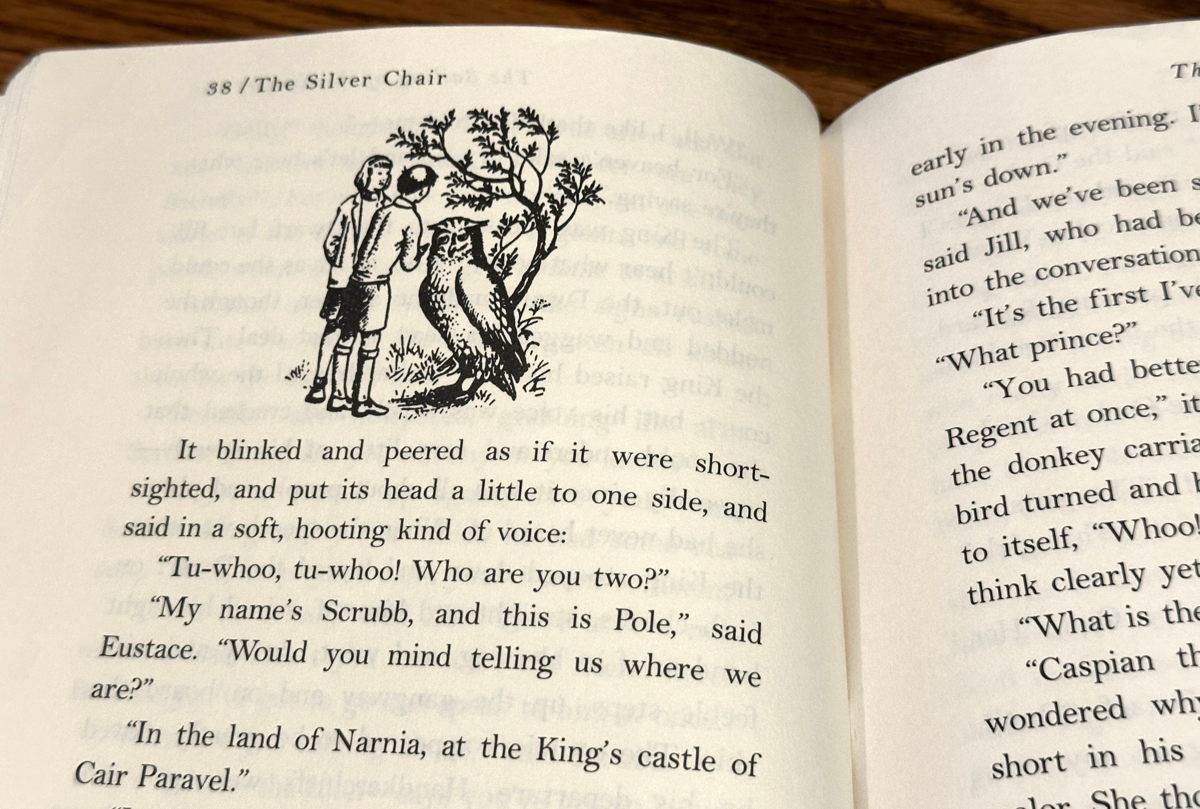
I saw “The Lion, The Witch and the Wardrobe” as a kid back when it was in theaters, but never read any of the seven novels until now, age 27. It always struck me as a bit of a misfit series; none of my friends were fans, and some of the books had such strange, opaque names — “The Voyage of the Dawn Treader,” “The Silver Chair,” “The Last Battle” — that they never really drew my attention. The idea of these books being somehow deeply Christian always surprised and intrigued me, because that must have gone over my head when I saw the movie.
For a while now I’ve been curious how Christian themes would play into the series, but also a bit wary to find out, I guess because Christian children’s fantasy isn’t my usual genre. But when I saw the audiobooks were just a few hours each, I crammed them all into the last few weeks of 2025. In the grand scheme of my Narnia read-through, the points in this post really feel like nitpicks. I didn’t generally find the Christian stuff to be heavy handed or intrusive outside of “The Silver Chair.” Narnia being this sort of quasi-pagan land of talking animals helped, too. But looking back, this book was where the series felt the most crustily religious.