"The Russian Revolution: A New History" by Sean McMeekin
I recently finished reading “The Russian Revolution: A New History” by Sean McMeekin (2017). This was my first time reading a full book on the Russian Revolution; until now I’d been relying on a working knowledge gleaned from Twitter threads, YouTube videos, and things that were mainly about other topics. But when a friend mentioned they were reading this book and learning a lot, I took it as my signal to finally go in depth. I listened to the audiobook over the course of 11 days in November, mostly while going on walks and doing chores.
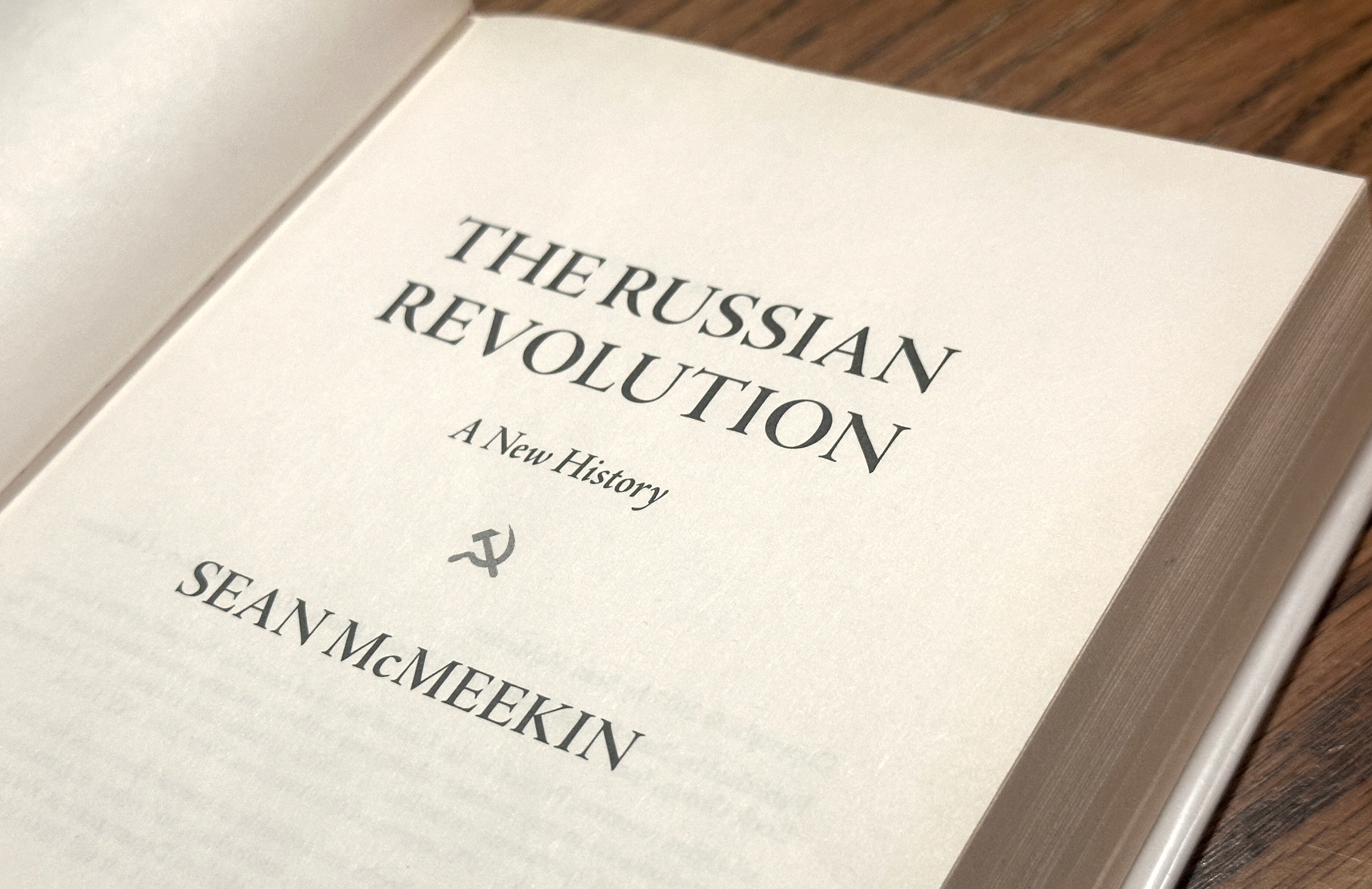
Many of the fine details are fading from memory already, partly because the topic is so murky and complicated and partly because I listened pretty casually. But I think I succeeded in coming away with a clearer sense of the revolution’s beginning, middle and end and a more complete mental roster of the people involved. The book keeps a brisk pace and never really gets lost in the weeds. It was a satisfying primer on the revolution’s events, its long-tail consequences and its evolving place in cultural memory.
Broadly speaking, McMeekin tells the story of a promising country, where big problems existed but trends were generally positive, tragically prevented from reaching its full potential by a cruel twist of history – the revolution – which could have, and should have, been prevented. You can practically feel McMeekin frowning and shaking his head as he ticks through the events. Personally, I think he has a pretty convincing case that the revolution was a bad deal, but I don’t think the way he presents it will win many new converts – more on that below.
Here are four of the author’s main points, as I saw them, followed by a few things I didn’t like about the book.
1. There was “nothing inevitable” about the Russian Revolution, and it could have gone in any direction at any time. It was characterized by “crazy twists and turns” and “filled with might-have-beens and missed chances” that could have left Lenin “a footnote in the history of Russia, and of socialism,” McMeekin writes. He describes the Bolsheviks’ “hostile takeover” of the Russian army as “an audacious, chancy, close-run affair that was nearly thwarted at many critical moments.” All of this flies in the face of clichés about “eschatological ‘class struggle’ borne along irresistibly by the Marxist dialectic,” he notes.
2. While Russia was fighting Germany in World War I, Vladimir Lenin was “literally on the German payroll.” It turns out this is a long-running historical rabbit hole with lots of back and forth, but McMeekin puts a lot of emphasis on it. Here’s how he puts it: At the time of the revolution, Lenin was living as an exile in Europe, likely to have “little impact” on the situation back in Russia. But he was on the radar of German intelligence, which was then engaged in dispatching “socialists of all stripes” to cause chaos on the Russian homefront. Lenin crossed Germany on a train ride back home (with help from the German government, McMeekin insinuates). Once in Russia, he was “fueled by German subsidies,” and the Bolsheviks printed propaganda in “virtually unlimited quantities … made possible by German subsidies” — over $1 billion in today’s money, McMeekin writes. Germany’s investments paid “immediate dividends” when Lenin pushed for Russia to exit the war, and appeared to have “paid off handsomely” when his party agreed to significant concessions and reparation payments. McMeekin portrays this relationship souring over time as the Germans begin to realize the chaotic, violent forces they’ve unleashed in Russia. Almost too Shakespearean to be true, I thought this was one of the book’s more interesting storylines.
3. Lenin and the Bolsheviks were lucky to have incompetent enemies. Their success was due, in large part, to the constant blundering of their rivals. Here’s one of many examples: After trying and failing to take over the revolutionary government, the Bolsheviks were nearly smashed by the subsequent crackdown. Other revolutionaries almost succeeded in cancelling the Bolsheviks over their treasonous German connections, getting close enough that Lenin fled to Finland. But the non-Bolshevik in charge, Alexander Kerensky, fumbled the ball: in a bid to consolidate power against another perceived threat, he freed Bolsheviks from prison and allowed them to rearm. They “promptly seized forty thousand rifles from a government arsenal,” and in elections held shortly thereafter, they “recorded a stunning victory.” They ultimately took control of the government the following month.
At the end of the book, McMeekin spins this into his closing message:
“The only lesson we can safely draw from [the Russian Revolution] is that statesmen bear grave responsibility, especially in wartime, and that a country pressed to the limits of its endurance must pray that its leaders display better judgment than the tsar, Rodzianko, and Kerensky did in 1917.”
4. “The political worm is turning again.” This is McMeekin’s ominous way of warning that he sees kernels of the Russian Revolution in modern politics. His chief examples are “the popularity of openly avowed socialists, such as Bernie Sanders” and “the popularity of Marxist-style maximalist socialism on the rise again” in capitalist countries. He says the stories of the Russian Revolution and the “century of well-catalogued disasters” that followed are evidence that we need to “stiffen our defenses” against this stuff.
Today’s Western socialists, dreaming of a world where private prfoperty and inequality are outlawed, where rational economic development is planned by far-seeing intellectuals, should be careful what they wish for. They may just get it.
This is sort of his “big idea” that frames the book in its introduction and epilogue. I think there could have been something here, but it ultimately amounted to little more than a few paragraphs of fear-mongering about “Bernie Bro” types. It came off to me as cranky and unconvincing, very 2017, and probably reductive, but I don’t know, I’m probably just blind to the ravenous neo-Bolshevik hordes in my midst. A few things I didn’t like
The book has a bit of a contrarian feel to it, where it always seems the author is trying to disprove other historians and show you the light. I got the impression that he’s a guy who enjoys overturning old narratives, busting myths and fact-checking widely held beliefs. I’ll admit to being a contrarian myself, but when McMeekin combined it with his openly stated disgust for the revolution and its consequences, I couldn’t help but wonder how trustworthy the end result is.
Just as the book begins, McMeekin seems proud to contradict “nearly all histories of the revolution” by claiming that disgruntled soldiers weren’t a problem for Russia in 1917; in fact, “morale was trending up.” He later slaps down an alleged “image many of us have from popular histories” — of peasants rioting over bread prices — as a fable that “does not accord with the material facts.” I’m prepared to believe all this, but I didn’t feel like McMeekin’s writing showcased the sort of levelheaded even-handedness that would have allowed me to trust it coming from him.
Another historian of the Russian Revolution, Richard Pipes, wrote in the introduction to his own tome that he has never “read an account of the French or Russian revolution that does not reveal, despite most authors’ intention to appear impartial, where the writer’s sympathies lie.” I don’t think McMeekin had any intent to appear impartial. Maybe nowadays he is sufficiently vindicated by history that no pretense of impartiality is really necessary, just as historians of World War II rightfully don’t spend much time weighing the moralities of Nazism. But there’s something about the trollish way McMeekin phrases things that gives me the impression that he’s trying to get a rise out of somebody, and delighting in the effort. What I wonder is, might the facts, at times, potentially, get a bit twisted along the way?
Another weakness of this book is that I often wished its characters were rendered with more of a human touch. I never felt like I got a solid grasp of prime movers like Lenin, Trotsky and Kerensky. I often felt adrift on where they had come from and who they really were. I could notice patterns in how they behaved, but McMeekin didn’t do much to help me build those patterns into three-dimensional characters. In particular, I hoped to get a firmer sense of Lenin as a historical figure. He is naturally a main character of this book, but I came away with little sense of the man and his motivations, aside from occasional cliché references to his “indomitable will to power,” his “ferocious will to power,” his “ice-cold grasp of power relationships,” et cetera. I did, however, enjoy McMeekin’s rendering of Tsar Nicholas II: seemingly always in a train car hundreds of miles from where he should be and clinging to an absolutism that he paradoxically shows little interest or ability in actually wielding.
P.S.: Almost immediately after I finished this book, I started reading Pipes’ “The Russian Revolution” (1990). Weirdly enough, that book has almost exactly the same cover as this one and seemingly much of the same point of view.
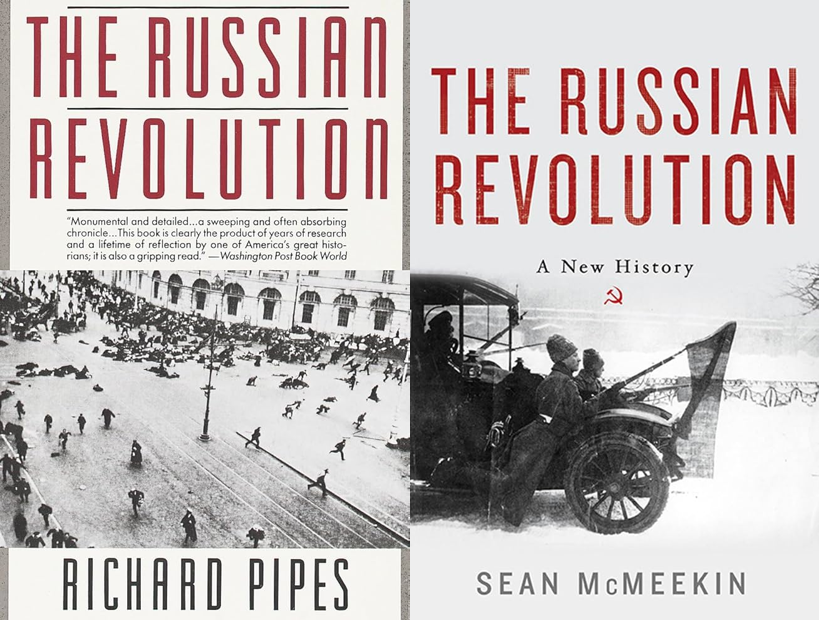
I’ve been finding Pipes’ book to be significantly superior: deeper, more analytical and less willfully incendiary – but also about twice as long.